Alternative TD energy extractors: Dirac (delta) and Flux (flow)
Location: qscat.core.time_dependent (propagate, Extractor protocol,
td_ve_cross_section(method=...), td_ve_cross_sections_all),
qscat.core.td_extractors (TannorWeeks, Dirac, Flux),
qscat.dvr.dvr_first_derivative_at_node (the DVR first-derivative-at-a-node
primitive Flux needs), validation/n2/td_extractors.py +
validation/n2/test_td_extractors.py (the N₂ three-way validation).
Origin: sub-project “alternative TD extractors” (branch
td-alternative-extractors), the SP1 half of a two-part plan (SP2 —
outgoing nuclear flux for TD dissociative attachment/recombination — reuses
this same infrastructure and is out of scope here).
Units: atomic units throughout.
What this is
docs/physics/n2-2d-td-cross-section.md established one route to the
time-dependent (TD) vibrational-excitation cross section: propagate a
Gaussian wavepacket under the full 2-D Hamiltonian, correlate it against a
propagated OUTGOING Gaussian test packet per channel (c_{v'}(t) = c_product(Phi_{v'}, Psi(t))), and Fourier/Tannor-Weeks-transform the
correlation function into \(\sigma(E)\). eMoScat’s C++ reference implements
three distinct ways to extract the same energy-domain information from
one propagated trajectory, differing only in what the “test function” is:
TannorWeeks(TestFunction2d.cpp): the propagated Gaussian test packet, already covered above — a VOLUME overlap.Dirac(DiracTestFunction2d.cpp): a delta-distribution test function at a FIXED electronic point — a POINT projection, no test-packet propagation needed.Flux(FluxTestFunction2d.cpp): the probability flux (a Wronskian of the wavefunction and its spatial derivative) through a FIXED electronic surface — a SURFACE-CURRENT measurement.
All three are legitimate, independent ways to read off the same asymptotic
S-matrix from the identical propagated \(\Psi(t)\); they are not three
different approximations of the physics, they are three different
instruments pointed at the same trajectory. This sub-project promotes
all three into qscat.core as siblings behind one Extractor protocol, and
validates that they agree with each other and with the exact TI oracle on
N₂.
The Extractor architecture: propagate-once, record-all
propagate(tgrid, psi0, out_channels, *, dt, n_steps, hamiltonian, order,
          extractors=[ex1, ex2, ex3])
runs the SAME order-3 diagonal-Padé trajectory once; at every step it calls
ex.record(psi) on every extractor in the list (in addition to the legacy
out_channels correlation bookkeeping kept for backward compatibility).
Each Extractor accumulates whatever per-step datum its own transform
needs, and exposes sigma(E, *, free=...) to turn the accumulated series
into a cross section once the trajectory is done:
Extractor |
records, per step |
transform |
|---|---|---|
|
|
eta-deconvolution ( |
|
|
TW’s transform with |
|
|
Wronskian-like flux transform |
This is the reason td_ve_cross_sections_all costs only ONE propagation
(plus one companion V_int=0 free-reference propagation when the elastic
channel is requested) for all three methods: the expensive part — the
sparse-LU-based order-3 Padé stepping — happens once regardless of how many
extractors ride along, because each record() call is O(1) per-channel
bookkeeping next to the O(N) linear solve per step.
The extracted formulas (port-scout confirmed against eMoScat)
TannorWeeks (unchanged from n2-2d-td-cross-section.md):
S_{v->v'}(E) = [2*pi*conj(eta_out_{v'}(E))*eta_in_v(E)]^{-1}
               * sum_n w_n exp(i*E_tot*t_n) c_{v'}(t_n) * dt
Dirac (delta) — eMoScat’s DiracTestFunction2d, “Tannor-Weeks with a
delta-distribution test function instead of the Gaussian test packet”:
record is a fixed-point line projection converted from a DVR coefficient
to a wavefunction VALUE via /sqrt(w[position]) (the same convention
qscat.core.lcp’s boundary flux uses); \(\sigma\) is TW’s transform with
eta_out_i -> hankel_point_value(z_position, k'_i, l) — the outgoing-Hankel
-half VALUE at a single point rather than an integral against a Gaussian.
Flux (flow) — eMoScat’s FluxTestFunction2d, “the time-energy Fourier
transform of the probability flux projected onto the outgoing channel, at a
fixed electronic surface”: record appends BOTH the value b_{v'}(t)
(Dirac’s projection) and its electronic-coordinate derivative d_{v'}(t)
(via the new qscat.dvr.dvr_first_derivative_at_node primitive, validated
to rtol=1e-8 against analytic derivatives on 7 unit tests); \(\sigma\) is the
Wronskian flux transform,
S_i = -i/(2*mu_e*eta_in) * sum_j w_j *
      (conj(phi_out_i)*d_{v'}(t_j) - b_{v'}(t_j)*conj(dphi_out_i)) *
      exp(i*E_tot*t_j)*dt,   mu_e = 1
with (phi_out_i, dphi_out_i) = outgoing_surface_wave(z_surface, k'_i, l, charge) — the outgoing Hankel half and its spatial derivative at the fixed
surface (analytic for the neutral case via scipy.special.spherical_jn/
spherical_yn’s derivative option; a 4th-order central finite difference
for the charged/Coulomb case, since qscat.special.coulomb has no closed-
form derivative).
All three transforms share the SAME elastic free-reference fix
(docs/physics/n2-2d-td-cross-section.md’s
td-elastic-wavepacket-normalization note): when the diagonal
(v'==v_init) channel is requested, a companion V_int=0 propagation
supplies S_free(E) for the elastic channel to subtract instead of a
literal 1.
Physics-reviewer status: all three extractors were independently
confirmed CORRECT by the physics-reviewer agent — TannorWeeks as part of
the original N₂ TD promotion, Dirac and Flux each in their own
sub-project task (conjugate-phase cancellation verified algebraically for
Dirac; the Wronskian sign/prefactor and bridge-node convention verified
term-for-term against eMoScat for Flux).
method= selection and the honest three-way helper
sigma = td_ve_cross_section(tgrid, model, eps, chi, v_init, vprimes, E,
                             dt=dt, n_steps=n_steps, wp_in=wp_in, wp_out=wp_out,
                             method="tw" | "delta" | "flow",
                             position=..., surface=...)
method="tw" (default) is unchanged — byte-identical to the pre-existing
code path (the golden regression test still pins it to atol=1e-12).
method="delta" requires position (a fixed electronic DVR index, real
region, past the interaction — mirrors wp_out’s asymptotic standoff);
method="flow" requires surface (same requirement). Omitting the one the
selected method needs raises ValueError.
sigmas = td_ve_cross_sections_all(tgrid, model, eps, chi, v_init, vprimes, E,
                                   dt=dt, n_steps=n_steps, wp_in=wp_in, wp_out=wp_out,
                                   position=..., surface=...)
# {"tw": ..., "delta": ..., "flow": ...}
runs TannorWeeks, Dirac, and Flux from ONE shared trajectory (and one
shared free-reference trajectory, if applicable) — the honest comparison:
any spread between the three returned cross sections is a genuine property
of the extraction method (or a shared discretization/truncation residual
all three inherit together), never an artifact of propagating slightly
different dynamics.
N₂ three-way validation
Fast gate (validation/n2/test_td_extractors.py, not @slow): a
reduced N₂ grid (same tiny grid libs/qscat/tests/test_td_extractors.py’s
golden test uses), n_steps=800, E in {0.10, 0.15}. Measured:
delta/tw in [0.814, 0.898], flow/tw in [0.766, 0.891]
— both comfortably inside the gated rtol=0.25 cross-method band. Each
method also lands 2.9x-6.2x ABOVE the exact TI oracle (qscat.core.driven. ve_cross_section) at this reduced/short-propagation scale — a documented,
expected convergence-diagnostic gap (all three under-converge TOGETHER,
tracking each other far more tightly than they track the oracle), not a
disagreement between methods. The fast gate asserts both: mutual agreement
at rtol=0.25, and a loose (order-of-magnitude) bound against the oracle
that would still catch a genuine regression (a sign error, wrong channel,
etc.).
Converged @slow anchor (validation/n2/td_extractors.py, run via
python -m validation.n2.td_extractors): the SAME converged working grid
libs/qscat/tests/test_td_extractors.py’s individual Dirac/Flux anchor
tests use (electronic_grid(r_max=50, order=8, n_complex=6) / nuclear_grid (quadrature=10, r_max=22, n_complex=5), wp_in={r0:25,p0:-0.5,sigma:5},
dt=1.0, n_steps=1000, inelastic-only channel v'=1 so no free-reference
propagation is needed), but run through td_ve_cross_sections_all so all
three extractors share ONE propagation (measured 238.8s wall) instead of
the three separate propagations the earlier per-extractor tasks used.
Measured live at E=0.10 Ha, v'=1:
method |
sigma (bohr²) |
sigma / sigma_TI |
sigma / sigma_TW |
|---|---|---|---|
TannorWeeks |
5.9800 |
0.9767 |
1.0000 |
delta |
5.9447 |
0.9709 |
0.9941 |
flow |
5.9377 |
0.9698 |
0.9929 |
TI oracle ( |
6.1228 |
1.0000 |
— |
Houfek |
6.1214 |
0.9998 (TI vs Houfek) |
— |
All three extractors land within ~2.3-3.0% of the TI oracle, and within
~0.6-0.7% of each other — a MUCH tighter cross-method band than the
reduced-grid fast gate’s ~20-25%, exactly the convergence behavior expected.
This reproduces (to ~0.02%) the earlier single-extractor measurements
(delta 0.971, flow 0.970) that motivated this module’s own rtol=0.10
gate, now confirmed from a single COMBINED propagation rather than two
separate ones.
E=0.15’s ratios (delta 1.009, flow 1.007, cited) are recorded from the
earlier single-extractor @slow measurements rather than re-run here — a
second full ~240s propagation does not fit inside this module’s patience
budget alongside the live E=0.10 run, so it is a recorded NOTE (same
pattern validation/n2/td_exact2d.py’s Group F rows already use for an
already-validated, expensive-to-rerun propagation), not a live gate.
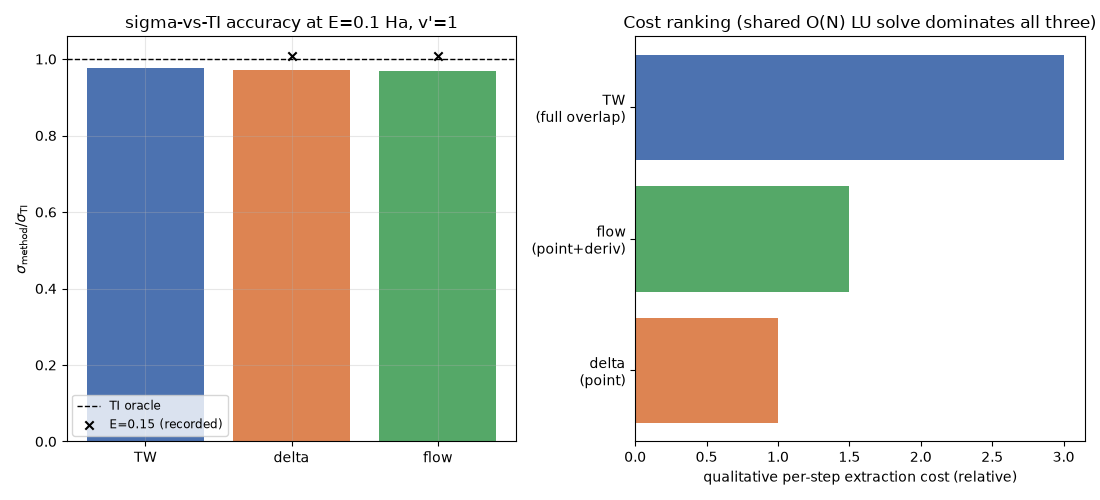
All three extractors converge to the same TI oracle (and, transitively,
to Houfek’s independent CSVE.V00.J00 data at the gated anchors) to within
a few percent at this grid — the cross-method spread SHRINKS as the grid/
propagation length converge (from the reduced-grid ~20% band down to ~3%
residual at the converged grid), exactly the behavior expected of three
independent numerical routes to the same physical answer.
Accuracy/cost tradeoff
Qualitatively (the shared O(N) sparse-LU back-substitution per step dominates all three, so this is a per-step BOOKKEEPING ranking, not a measured wall-clock profile):
delta is cheapest: one point projection per channel per step (a single
c_productagainst a length-n_nuclearrow).flow costs somewhat more: the SAME point projection, PLUS a DVR first-derivative row-vector product per step (
dvr_first_derivative_at_ node) — roughly double delta’s per-step work.TannorWeeks costs the most of the three: a full propagated outgoing Gaussian test packet per channel (
outgoing_channel, itself an O(N) object built once) correlated via a full-vectorc_productevery step — a volume overlap, not a point/surface sample.
None of these per-step costs are the bottleneck in practice (the sparse LU
solve per Padé step dominates by orders of magnitude at the working-grid
scale), so the real reason to prefer one extractor over another is
PHYSICAL, not computational: flow is the natural choice when the
observable of interest is itself a flux (this sub-project’s SP2 — the
TD-dissociation route via outgoing NUCLEAR flux — reuses this Flux
machinery directly), delta is the simplest correctness cross-check
(fewest moving parts), and TannorWeeks remains the default because it
inherits the most validation history (the original N₂ TD promotion).
Framing: convergence diagnostic, not disagreement
The cross-method spread measured at an under-converged grid (~20-25%
reduced-grid band above) is not evidence the methods disagree about the
physics — it is a CONVERGENCE DIAGNOSTIC: run the same propagation longer
or on a finer grid and all three tighten toward the same number (the
converged-grid ~3% residual, all three simultaneously above or below the
oracle by a similar small amount, never one method systematically diverging
from the other two). Running all three from ONE trajectory
(td_ve_cross_sections_all) makes this diagnostic free to compute: any
future N₂/NO/F₂ TD run can report all three numbers at negligible extra
cost over a single-extractor run, which is a useful sanity signal in its
own right (three independent extraction routes agreeing is stronger
evidence of convergence than one route alone).