H₂⁺ — the first ionic target¶
H₂⁺ is the only ion in this repository. Every molecule before it — N₂, NO, F₂ —
is a neutral electron–diatomic scattering problem; H₂⁺ is e⁻ + H₂⁺(v) → H + H,
dissociative recombination (DR), and the scattering electron sees the ionic
core’s +1 charge. qscat.model.H2P is verified to be an IonicResonanceModel
with charge = -1 (the neutral models — N2, NO, F2 — are all
DiatomicResonanceModel with charge = 0). That single sign changes three things
at once: the incident wave becomes a long-range Coulomb wave rather than a free
one, the electronic grid has to reach ~1300 bohr to hold it, and instead of one
dissociation channel there is a whole Rydberg series of exit channels — the
neutral H₂’s bound electronic states, accumulating at the continuum edge, cut off
at a measurable number (N_CHANNELS = 3 here). It is also, for exactly that grid
reason, the first model in this repository that does not run on a laptop.
The model — form and parameters
qscat.model.H2P (IonicResonanceModel), values printed directly from the model
object:
parameter |
value |
|---|---|
|
918.076 |
|
1 |
|
−1 |
|
0.1027 |
|
2.0 |
|
0.69 |
|
1.6435 |
|
6.2 |
|
0.0125 |
|
1.15 |
|
22.5 |
Reproduce with:
from qscat.model import H2P
print({k: v for k, v in vars(H2P).items() if not k.startswith("_")})
The ion Morse v0(R) folds in the 1/R proton–proton repulsion rather than
carrying it as a separate term; the electronic surface is v0(R) + v_int(r,R) + ℓ(ℓ+1)/(2r²) + charge/r, where charge/r = −1/r is the ionic electron–core
Coulomb attraction. mu = 918.076 is m_p/2 for the modern proton mass, given by
three independent published sources (Hvizdoš 2016 Table 1.1; Váňa 2017 Table 1.2;
Hvizdoš et al., Phys. Rev. A 97, 022704 (2018) §II A) — eMoScat’s own JSON
deck instead carries 918.25, which those three sources contradict; the port
originally inherited eMoScat’s value and it was corrected on 2026-08-15.
The first non-laptop model¶
The Coulomb tail’s long range forces a large electronic grid — the full deck reaches
1300 bohr electronically and 14 bohr nuclearly, giving ~1.15 million unknowns
(1,150,108 measured, 19,507,356 nonzeros). That is Docker/MUMPS territory, not
laptop-runnable: a measured full-deck energy point costs 17.4 s on a 32-core,
123 GB x86-64 host under MUMPS (peak RSS 4.34 GB), so a σ(E) sweep costs roughly an
hour per 200 energies — an overnight job, not a multi-day one. A smaller
config.proxy_grid() (electronic → 60 bohr) gives a laptop-feasible
well-posedness/threshold gate, not a converged cross section. No independent
golden σ_DR data ships with this repository (eMoScat’s own output file is absent
from the snapshot), so — as with NO/F₂’s dissociative attachment — the exact
solver is the oracle here too.
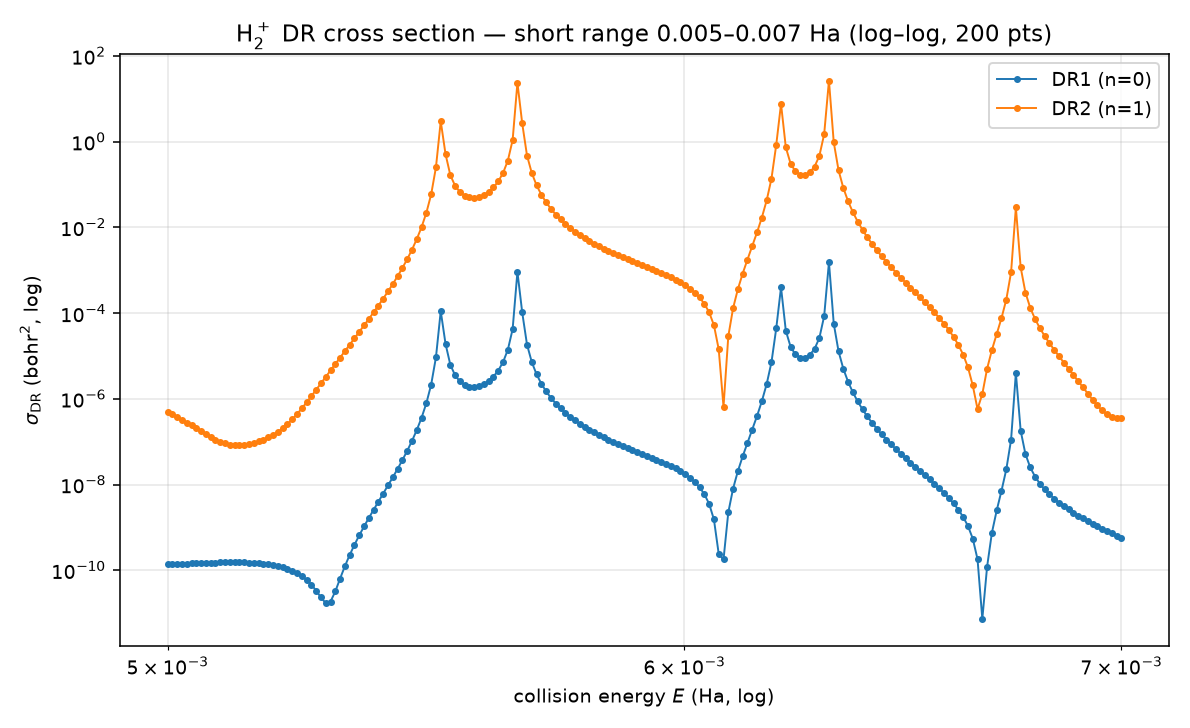
The DR1 (n=0) channel peaks at E ≈ 6.31×10⁻³ Ha, σ ≈ 1.54×10⁻³ bohr² above a
~10⁻¹⁰ background; DR2 (n=1) is ~10⁻⁶; DR3 (n=2) is closed in this window
(threshold ≈ 0.0426 Ha).
The Coulomb-generalized driven Lippmann–Schwinger solve, looped over the Rydberg
exit series. Checked against a prior external reference sweep: the published
ω_i^j level table (53 levels) agrees to ≤4e-6 Ha, but σ_DR itself carries two
open discrepancies — a ~30% systematic deficit in the DR1 channel, and a
runaway near a vibrational threshold (7.6×/3.7× too high, DR0/DR1) that grows to
100–700× too large right at a Rydberg channel’s opening.
Poles of the full 2-D S-matrix, checked against a Born–Oppenheimer basis by overlap rather than trusted on angle stability alone. Detail below.
Angle stability is necessary — and not sufficient¶
qscat.core.exact_resonance_states finds poles by two-angle ECS stability: an
eigenvalue that does not move when either the electronic or the nuclear ECS
rotation angle does. On H₂⁺’s three published DR energy windows that test found 57
angle-stable states. Overlapping each one against a Born–Oppenheimer basis
(qscat.core.bo/assignment, the c-product overlap) turned up two failure modes
angle stability alone cannot see:
Four of the 57 are not resonances at all. They pass angle stability — the
eigenvalue genuinely does not move as the contour rotates — but score overlaps of
6×10⁻⁴ to 7×10⁻³ against every state in the Born–Oppenheimer basis, where the
genuine resonances score 0.87–0.99. They are rotated-continuum eigenvalues
that happen to sit in a stable corner of the spectrum, not physical states. (At
E = 0.004479 Ha the best overlap is 0.0006 — three orders of magnitude below
even the low end of the genuine-state range.)
A further 18 of the 57 are box-limited, which the overlap is structurally
blind to. The c-product cancels the rotated ECS tail by construction — that is
what makes it the correct pairing rule — so a state with 97% of its probability
outside the unscaled region still overlaps at 0.99 with the Born–Oppenheimer
product it genuinely is. real_weight (the fraction of |Ψ|² inside the unscaled
region) is the separate check the overlap cannot make: across one window it
collapses from 0.682 at Ry₁₁ to 0.010 at Ry₁₆, because those high-n Rydberg
orbitals (⟨r⟩ ~ n²) are simply larger than the 300-bohr box. 18 of 57 fall below
a 0.5 real_weight threshold — reported, not deleted, since the identification
still stands; nothing about their shift or width is quotable until the box grows.
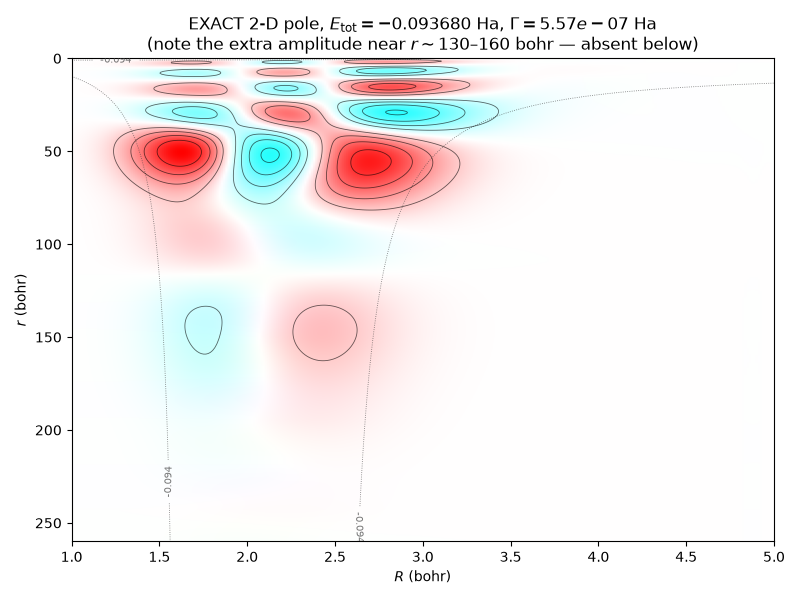
Fig. 1 The exact 2-D pole at E_tot = −0.093680 Ha (E ≈ 0.0039 Ha), Γ = 5.6×10⁻⁷ Ha.¶
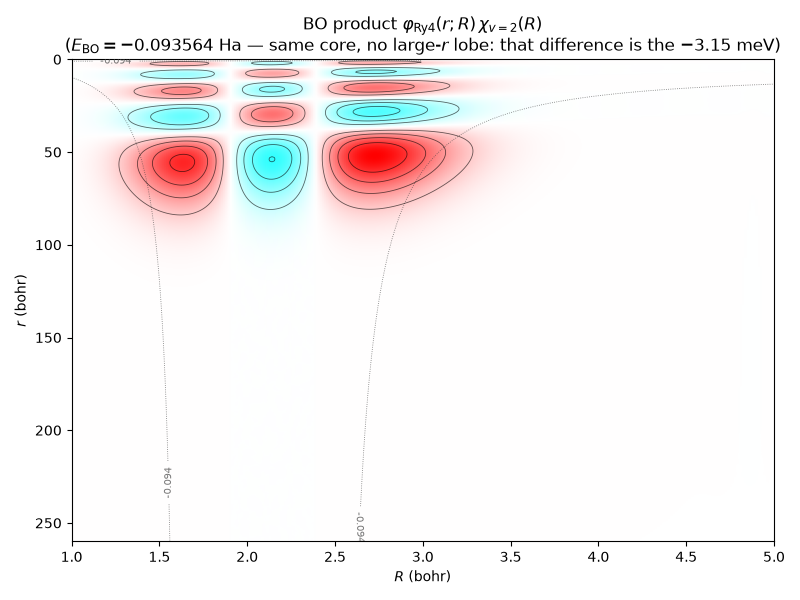
Fig. 2 The Born–Oppenheimer product φ_Ry4(r;R)·χ_v=2(R) at E_BO = −0.093564 Ha — the
state the approximation asserts the one above is. They share a core (five radial
lobes, two nodes in R, the same turning surface); the exact state carries extra
amplitude near r ≈ 130–160 bohr the product has nowhere to put.¶
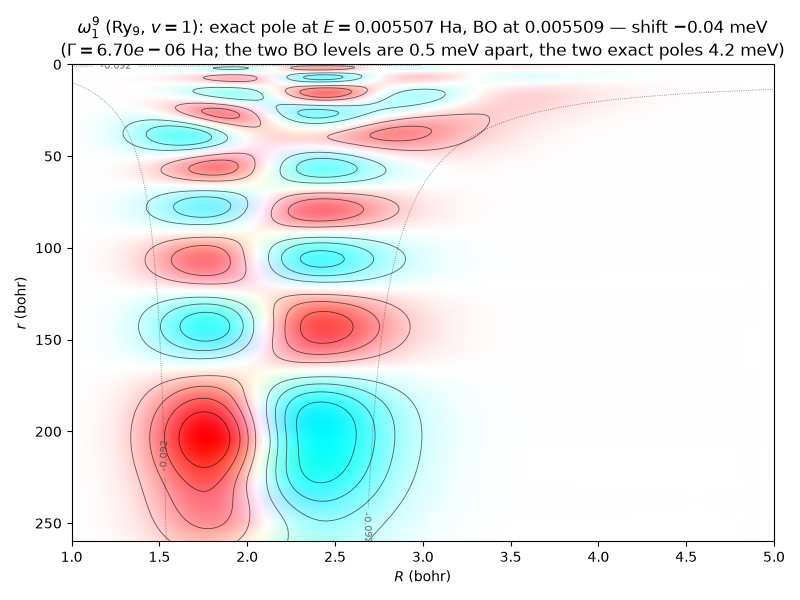
Fig. 3 ω₁⁹ (Ry₉, v=1): diffuse, ~9 radial lobes reaching past 250 bohr. Overlap
0.970 — nearly pure, and it barely moves against the Born-Oppenheimer level.¶
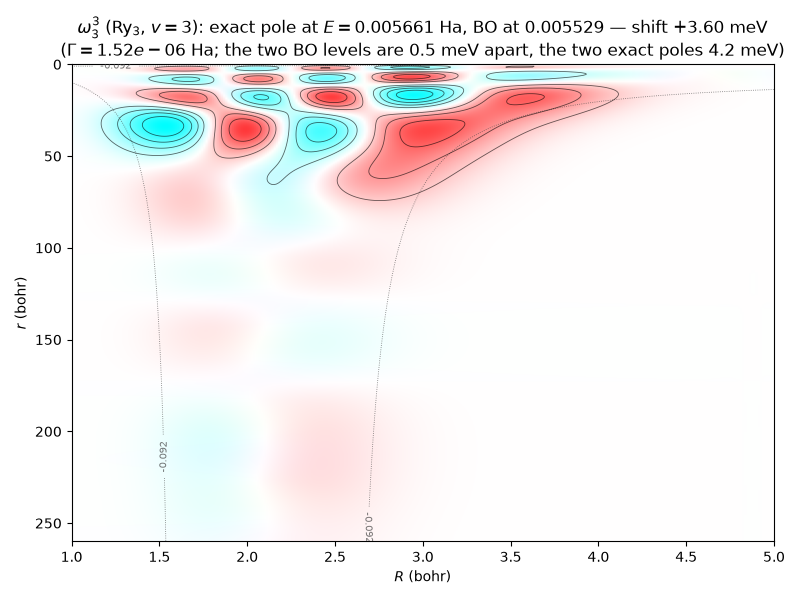
Fig. 4 ω₃³ (Ry₃, v=3): compact, confined inside ~70 bohr. Overlap 0.783 — strongly
mixed, and it carries almost the whole splitting of a near-degeneracy with the
pair above.¶
Once the four non-resonances and the 18 box-limited states are set aside, the
BO error itself sorts by regime, not by level index — an eightfold split
between diffuse high-n Rydberg states (median 0.457 meV) and compact low-n
ones (median 3.702 meV), both larger than N₂’s 0.22 meV
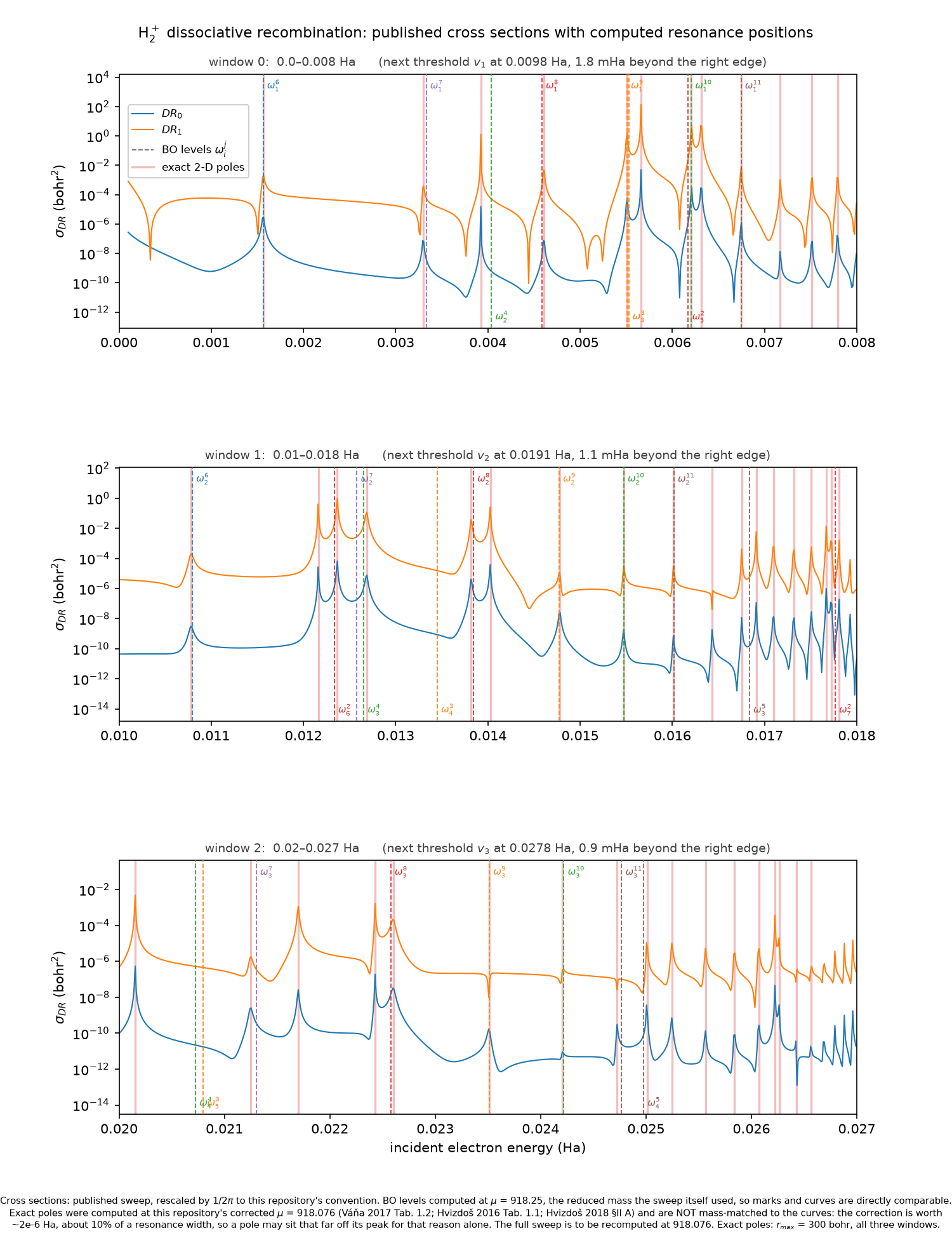
(Exact (non-Born-Oppenheimer) resonance states of the 2-D model). The Born-Oppenheimer levels and the
exact poles, marked on the DR sweep that measures both:
What is established, and what is not¶
Quoted directly from the resonance-states note:
claim |
status |
|---|---|
exact poles land on the published peaks, 0.2–0.3 widths, all three windows |
measured against data the poles were not fitted to |
4 of 57 angle-stable poles are not resonances |
overlaps 6e-4…7e-3 against a basis proven complete at those energies |
the BO shift splits by regime, 0.457 vs 3.702 meV median |
24 quotable pairs |
18 of 57 poles are |
the high- |
pole POSITIONS are box-converged |
|
the pole COUNT is not converged |
18→22, 13→10, 14→13 across the three windows — not even monotone |
per-level shifts for the 6 |
not quoted — their partner is outside the basis |
σ_DR near a threshold |
wrong, 100–700× too large |
Both level/pole figures above are computed at μ = 918.25 (the value the σ_DR
reference sweep itself used), not the model’s shipped 918.076 — a deliberate
choice so the marks and the curve are on the same footing; the ~2×10⁻⁶ Ha the
mass correction is worth would otherwise read as ~10% of a resonance width.
Where to read more¶
The Coulomb channel, the discretisation, and the full DR cross section including its two open discrepancies against an external reference sweep: H₂⁺ dissociative recombination (the first ionic model). The exact resonance-state verification — angle stability, the overlap test, and the box-limited states: Exact resonance states of H₂⁺, against the Born–Oppenheimer picture. The general two-angle method this is built on, and its first (N₂, neutral) application: Exact (non-Born-Oppenheimer) resonance states of the 2-D model, N₂ — the benchmark target. The Born–Oppenheimer resonance levels these exact poles are compared against: BO/LCP resonance levels — quasi-bound vibrational states of the anion.