NO and F₂ — no independent data
Neither of these molecules has a published cross section this repository can check
against. N₂ has Houfek’s independent CSVE.V00.J00 data; NO and F₂ do not. For both,
the exact 2-D driven-equation solver (qscat.core.driven.ve_cross_section /
qscat.core.dissociation.da_cross_section) is the oracle, and every approximation
below is measured against that solver’s own output. Agreement here is
self-consistency between two routes through the same repository, not agreement with
an external experiment or an independent calculation. That distinction is the most
important thing on this page and it is not softened anywhere below.
Same model and method as N₂ — H = −½∂²_r − (1/2μ)∂²_R + v0(R) + l(l+1)/2r² − λ(R)e^{−α_c r²} — differing only in the fitted parameters
(qscat.model.{NO,F2}). Adding each molecule was data + validation, not new solver
code. Atomic units throughout.
The models — form and parameters
Both are DiatomicResonanceModel with charge = 0 (verified: type(NO).__name__ == type(F2).__name__ == "DiatomicResonanceModel"), the same neutral-diatomic form N₂
uses. Values printed directly from the model objects:
parameter |
NO |
F₂ |
|---|---|---|
|
13614.16 |
17315.99 |
|
1 |
1 |
|
0.2363 |
0.0598 |
|
1.571 |
1.5161 |
|
2.157 |
2.6906 |
|
6.367 |
18.849 |
|
5.0 |
3.213 |
|
2.0843 |
1.832 |
|
6.05 |
18.145 |
|
2.285 |
2.595 |
|
1.0 |
3.0 |
|
0 |
0 |
Reproduce these with:
from qscat.model import NO, F2
print({k: v for k, v in vars(NO).items() if not k.startswith("_")})
print({k: v for k, v in vars(F2).items() if not k.startswith("_")})
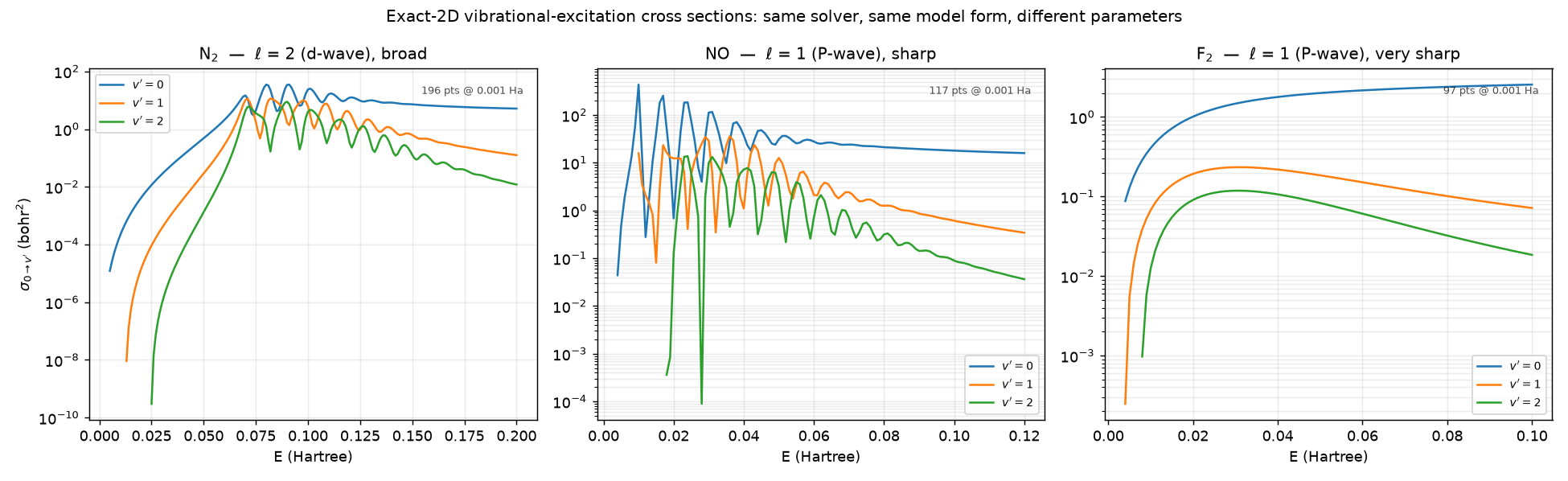
Sharper, lower resonances than N₂
Both partial waves are ℓ = 1 (P-wave) rather than N₂’s ℓ = 2 (d-wave), and both
resonances sit lower and narrower:
partial wave ℓ |
α_c |
neutral vib. spacing ε₁−ε₀ |
resonance window |
|
|---|---|---|---|---|
N₂ |
2 (d-wave) |
0.40 |
0.0124 Ha |
~0.07–0.10 Ha (broad) |
NO |
1 (P-wave) |
1.00 |
0.0091 Ha |
~0.02–0.05 Ha (sharp) |
F₂ |
1 (P-wave) |
3.00 |
0.0039 Ha |
~0.01–0.04 Ha (very sharp, near threshold) |
F₂ is weakly bound (D0 = 0.0598 Ha, ~1.6 eV) with an extremely sharp near-threshold
resonance — boomerang features only ~0.004 Ha wide — which is why F₂ is a famously
strong dissociative-attachment (DA) system: its DA channel is exothermic
(threshold −0.0691 Ha, open at every E > 0), while NO’s opens at +0.1719 Ha
and N₂’s stays closed throughout the measured range (+0.5016 Ha). The three exact-2D
VE cross sections side by side:
Both curves in this figure are computed on each molecule’s own eMoScat production
deck (NO: 132×597 electronic×nuclear points; F₂: 132×974), not the shared N₂-style
grid — DA’s outgoing flux is in the nuclear coordinate and needs a much finer nuclear
grid to resolve (F₂’s exit wave has K_R ≈ 58, wavelength ~0.107 bohr; the coarse
shared grid does not converge it).
What has been computed
The exact 2-D driven-equation solve for both channels, on each molecule’s own
per-molecule nuclear deck. VE figures:
../physics/figures/no-2d-ti-cross-section.png,
../physics/figures/f2-2d-ti-cross-section.png. DA figures:
../physics/figures/no-2d-ti-da-cross-section.png,
../physics/figures/f2-2d-ti-da-cross-section.png.
The 1-D reduction, measured against the exact-2D DA oracle: systematically and energy-dependently wrong on F₂ (never a fixed percentage), and off by a ratio reaching 1.8×10⁹ on NO away from threshold, where it fails to reproduce the exponential decay at all. Detail below.
Keeps the full nonlocal Feshbach coupling instead of reducing to a local potential.
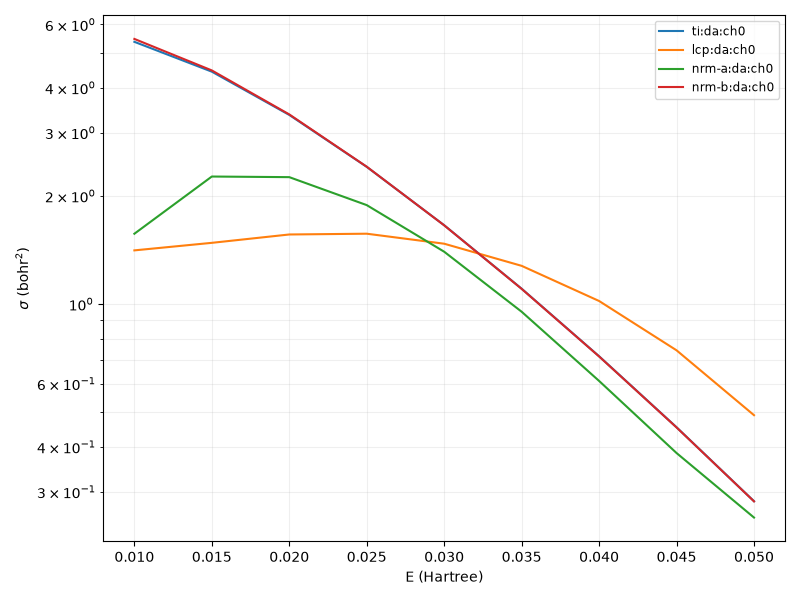
Closes almost all of the LCP’s gap on F₂; collapses by orders of magnitude on NO, for
reasons the investigation has not resolved. Figure:
../physics/figures/f2-da-nrm-vs-lcp-vs-exact.png.
Why a shared N₂-style nuclear grid does not converge F₂’s DA channel, and how the automatic discretisation tuner reproduces-and-beats eMoScat’s hand-tuned per-molecule deck once it is told to look at the resonance curve, not just the potential.
NO’s shape resonance is shipped as a single partial wave. Coupling it to
neighbouring partial waves through a physically motivated, non-spherical
interaction: only l = 1 hosts a resonance at all — O⁻ has one bound orbital,
2p — so the single pole is explained rather than merely observed. For the
angle-integrated VE cross section the fixed-wave reduction is a good
approximation, because a low-energy electron cannot resolve the anisotropy:
the truncation costs 2–7 % (σ-weighted) against a reference converged to
0.3–0.5 %.
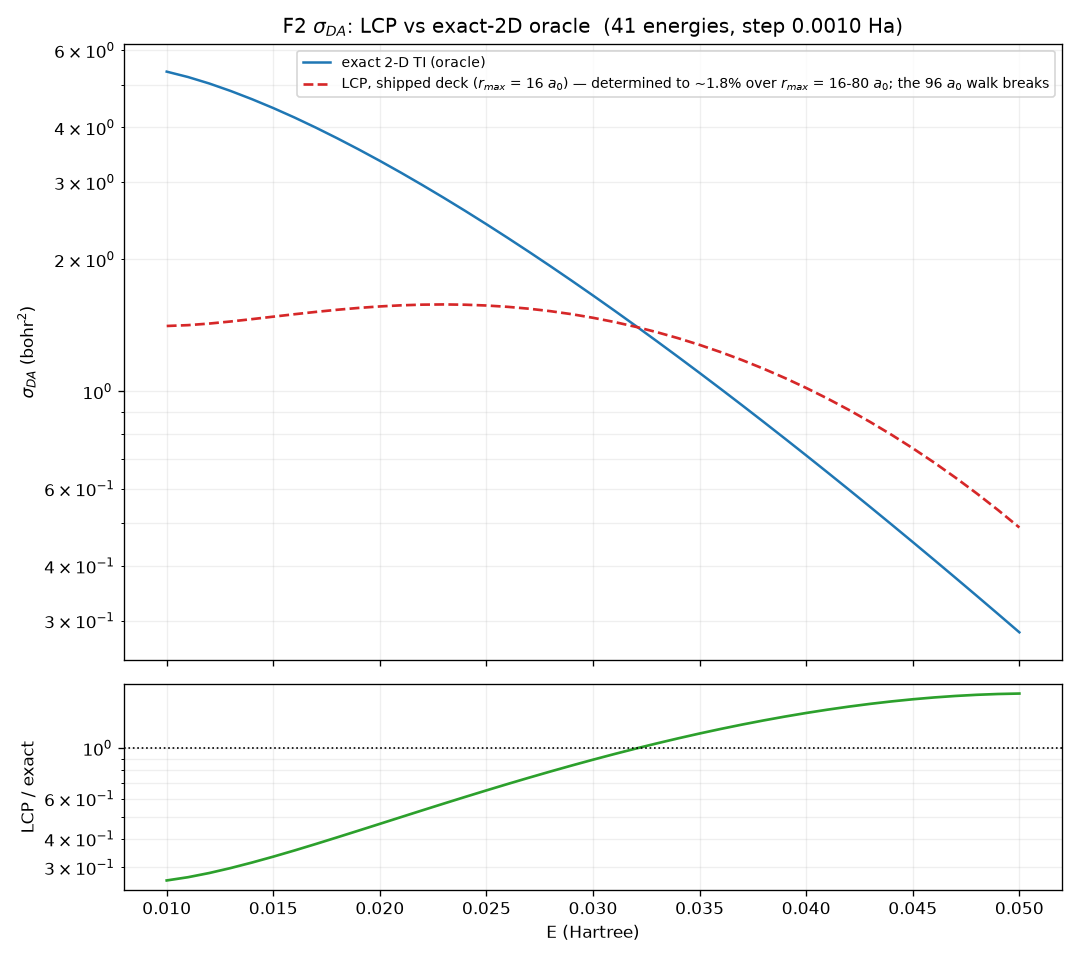
The LCP approximation — systematic and energy-dependent error
The local-complex-potential (LCP) reduction collapses the full electron–nuclear
problem to a 1-D nuclear problem on a complex potential V_d(R) − iΓ(R)/2. Its error
on σ_DA is not a fixed percentage — it is a signed, energy-dependent departure
that changes sign inside the measured range.
F₂, 41 energies over 0.010–0.050 Ha (recomputed 2026-08-17):
E (Ha) |
σ_DA LCP |
σ_DA exact |
LCP/exact |
|---|---|---|---|
0.010 (threshold) |
1.410 |
5.366 |
0.263 |
0.020 |
1.56 |
3.36 |
0.47 |
0.030 |
1.471 |
1.656 |
0.888 |
0.040 |
1.02 |
0.72 |
1.43 |
0.050 |
0.490 |
0.282 |
1.736 |
The exact σ_DA falls by a factor of 19 across this range while the LCP stays nearly
flat, so the ratio sweeps 0.263 → 1.736, crossing unity near E ≈ 0.032 — i.e. the
LCP’s relative error, |ratio − 1|, computed from the ratio column above, runs
from 11.2% (at the crossing, E = 0.030, |0.888 − 1|) up to 73.7% (at threshold,
|0.263 − 1|) and 73.6% (at E = 0.050, |1.736 − 1|): roughly an 11–74% error
band, not a single quoted figure. The LCP under-predicts below ~0.03 Ha and
over-predicts above it.
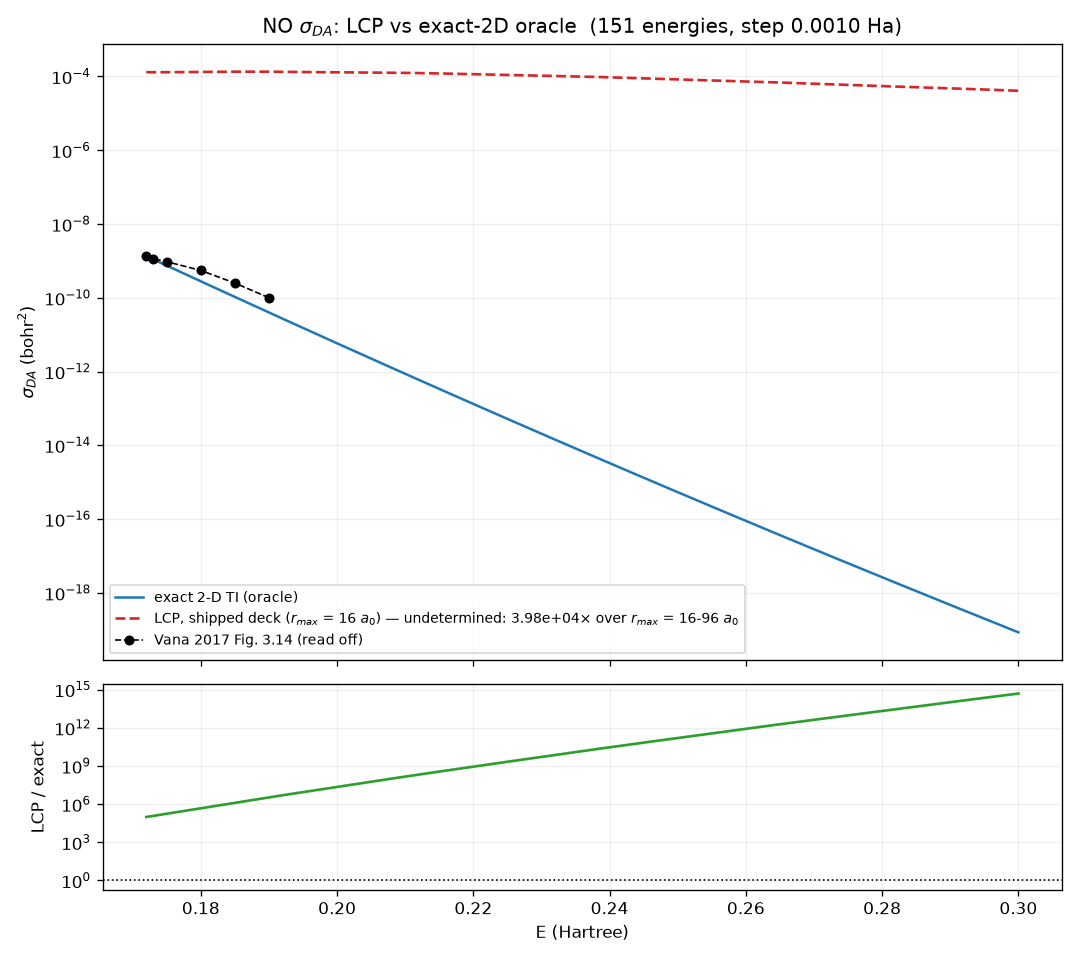
NO, 151 energies over 0.150–0.300 Ha: the exact σ_DA is a sharp spike at threshold (peak 0.0925 bohr² at E = 0.172) that then decays by thirteen orders of magnitude, to 1.8×10⁻¹⁴ at E = 0.300. The LCP does not decay — it stays near 10⁻⁴ across the whole range — so the ratio runs from 0.067 near the spike to 1.8×10⁹ at the top of the range. The LCP does not reproduce the exponential suppression of dissociative attachment away from threshold at all.
Source: NO and F₂ exact-2D VE cross sections (the model port).
The nonlocal resonance model — closes the F₂ gap, collapses on NO
The nonlocal resonance model (NRM, PRA 77’s Feshbach formalism) is a different
approximation from the LCP: instead of reducing the resonance to a local complex
potential, it keeps the full nonlocal coupling, expanded in a discrete-state basis.
Two discrete-state choices exist (A: the physical, R-dependent state; B: an
R-independent state with the Eq. (37) background term). Measured against the same
exact-2D da_cross_section oracle, on each molecule’s own eMoScat production deck:
F₂ — choice B reproduces the oracle.
E (Ha) |
σ exact |
σ LCP |
σ NRM-B |
LCP/ex |
B/ex |
|---|---|---|---|---|---|
0.010 |
5.36634 |
1.41038 |
5.46688 |
0.263 |
1.0187 |
0.020 |
3.35886 |
1.56292 |
3.36989 |
0.465 |
1.0033 |
0.030 |
1.65611 |
1.47242 |
1.65514 |
0.889 |
0.99941 |
0.040 |
0.71510 |
1.01869 |
0.71415 |
1.425 |
0.99867 |
0.050 |
0.28238 |
0.48945 |
0.28211 |
1.733 |
0.99903 |
Choice B reproduces the exact 2-D σ_DA to 0.06–0.33% at four of the five anchors, and to 1.9% at the lowest (E = 0.010, nearest threshold) — against the LCP’s own 11–74% band over the same anchors. That is choice B beating the LCP by factors of 39 / 163 / 189 / 319 / 758 at the five anchors respectively. Choice A (not shown, the physical R-dependent state) is markedly worse — it under-predicts and worsens toward threshold (A/ex: 0.901 → 0.292), 38–266× further from the oracle than choice B, matching the Born–Oppenheimer breakdown PRA 77 documents for DA.
NO — choice B collapses by five to eight orders of magnitude, unresolved.
E (Ha) |
σ exact |
σ NRM-B |
B/ex |
|---|---|---|---|
0.175 |
1.61389e-2 |
7.54001e-10 |
4.7e-8 |
0.180 |
1.56645e-3 |
2.83314e-10 |
1.8e-7 |
0.185 |
2.26604e-5 |
1.06926e-10 |
4.7e-6 |
0.190 |
7.07979e-5 |
4.05467e-11 |
5.7e-7 |
0.200 |
1.71756e-6 |
5.92119e-12 |
3.4e-6 |
None of the three approximations track the exact curve’s structure here: over these five anchors the exact σ_DA swings by a factor of 9397 (real, non-monotone structure), while the LCP swings by only 1.04×, NRM choice A (not converged, shown only because dropping it would hide one of the three routes) by 2.47×, and NRM choice B by 127× — all flat by comparison to the oracle’s 9397×.
This is genuinely unresolved: “No located defect, and no confirmed mechanism.”
An equation-by-equation audit against Eqs. (55)–(61) found the implementation
correct, and further hypotheses and mechanisms were killed by direct measurement
without resolving the collapse: a suppressed NO doorway (it is actually 3.4×
larger than F₂’s), wrong ingredients (E_n, V_dn, V_d validated against the
independent ECS pole to 0.1–2.6%), a wrong energy argument inside the coupling
kernel F (its local limit reproduces Γ(ε_loc, R) to a median of 0.977 on NO
and 1.011 on F₂), a badly built asymptotic electronic state, grid or quadrature
error (converged to seven figures), bad adiabatic state labelling (minimum
overlap 0.99998709), a threshold mismatch (three independent code paths agree to
9.0×10⁻¹⁴), and a doorway-position mechanism that was proposed and then refuted
by raising v_init. Two further dead ends are recorded separately: switching
the coupling F off entirely (which detunes rather than de-absorbs — it removes
the real level shift, not the loss mechanism), and setting Γ = 0 in the
already-validated LCP (which gives σ_DA exactly 0, so “no absorption ⟹ an upper
bound” has no basis even in the trusted method). One unverified hypothesis
remains open — NO’s exit momentum is small just above its DA threshold, which would
put an autodetachment survival factor deep in an exponential the note has not yet
computed — but it is explicitly flagged as unverified, not a finding.
This does not contradict PRA 77: the paper contains no NO or N₂ dissociative- attachment cross section at all, for any discrete-state choice — its only DA panels are for F₂. The NO run here extends more than twice past the highest energy the paper studied for NO, so this is an extension beyond the paper’s tested range, not a disagreement with it.
Source: The nonlocal resonance model (NRM).
Where to read more
The exact-2D VE and DA solves, the LCP reduction, and the per-molecule discretisation requirement: NO and F₂ exact-2D VE cross sections (the model port). The nonlocal resonance model, both its F₂ success and its unresolved NO collapse: The nonlocal resonance model (NRM). The automatic discretisation tuner, calibrated against F₂’s DA channel: FEM-DVR-ECS discretisation tuner: design, calibration, and gate. The shared model-independent engine both molecules run through, and the N₂ page that explains why N₂ alone can act as an anchor: qscat.core + qscat.model: the electron–diatomic VE-scattering engine, N₂ — the benchmark target.