NO and F₂ exact-2D VE cross sections (the model port)¶
Location: validation/diatomic/ (config.py — the per-molecule eMoScat nuclear
decks; test_diatomic.py — the cross-section gate). The per-molecule curve and figure
drivers this note’s committed figures came from were retired into apps/qscat-run, so
the curves are now produced from a config (e.g.
apps/qscat-run/examples/f2-da-lcp-vs-exact.yaml) rather than from solver code here.
Computed entirely through the promoted library qscat.core + qscat.model — the first
consumers of the generalization beyond N₂ (sub-project A). Origin: sub-projects B (NO) and
C (F₂) of the diatomic VE-scattering spec. Units: atomic units.
What this is¶
The exact 2-D time-independent vibrational-excitation cross section \(\sigma_{0\to v'}(E)\) for NO and F₂ — the same model and method as N₂,
differing only in parameters (qscat.model.{NO,F2}). Adding each molecule
was data + validation, no new solver code: a qscat.model registry entry + a
validation/diatomic/config.MoleculeConfig grid/energy entry + a driver calling
qscat.core.driven.ve_cross_section.
The oracle (no independent golden data)¶
Unlike N₂ (gated against Houfek’s independent CSVE.V00.J00), no independent cross-section
data ships for NO/F₂ — so the exact-2D TI solver is the reference (the research program’s
stance: the exact solution is the oracle, the LCP/TD approximations are under test). The
committed σ(E) curves are that oracle:
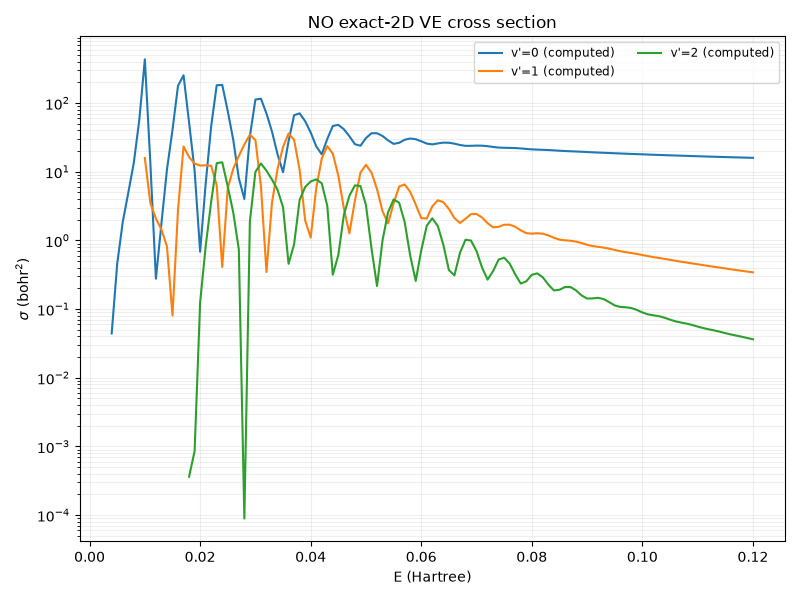
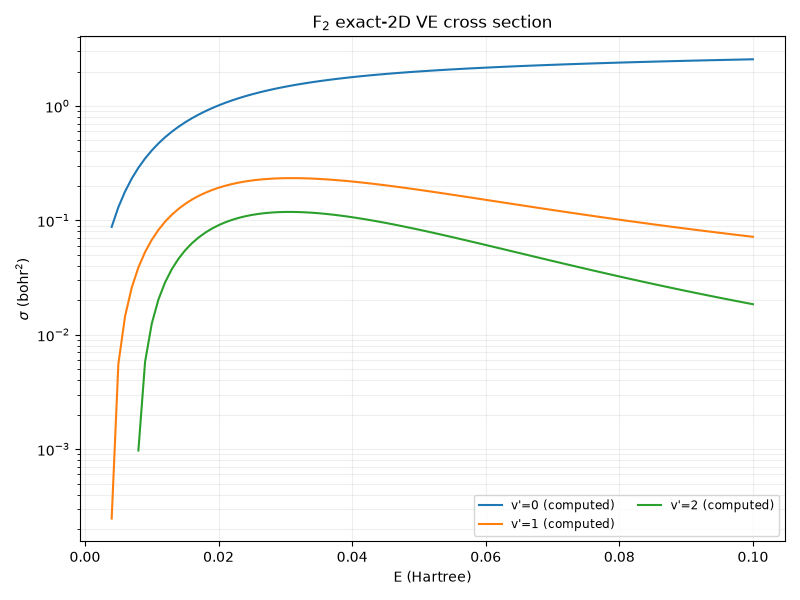
Both show clear boomerang oscillation structure from a low-lying shape resonance, decaying smoothly at higher E:
partial wave l |
α_c |
neutral vib spacing eps₁−eps₀ |
resonance window |
|
|---|---|---|---|---|
N₂ |
2 (d-wave) |
0.40 |
0.0124 Ha |
~0.07–0.10 Ha (broad) |
NO |
1 (P-wave) |
1.00 |
0.0091 Ha |
~0.02–0.05 Ha (sharp) |
F₂ |
1 (P-wave) |
3.00 |
0.0039 Ha |
~0.01–0.04 Ha (very sharp, near threshold) |
NO and F₂ have lower, sharper resonances than N₂: NO’s ²Π shape resonance sits low, and F₂ — weakly bound (D₀ = 0.06 Ha, ~1.6 eV), a strong dissociative-attachment system — has an extremely sharp near-threshold resonance with boomerang features only ~0.004 Ha wide.
Which grid these figures use. The curves above are computed on each molecule’s own
eMoScat production deck (grid: {preset: emoscat}, what apps/qscat-run uses):
NO (132, 597) and F₂ (132, 974) electronic × nuclear points. They are not on the
N₂-style shared grid.
Convergence. An earlier r_max study on the shared N₂-style grid (electronic
r_max = 16, nuclear r_max = 22) found σ(E) unchanged to <1 % at electronic r_max = 16/24/32
for NO — evidence that the sharp low-E swings are genuine resonance structure rather than grid
noise. That measurement stands, but it was made on the shared grid and is not a convergence
statement about the per-molecule decks these figures now use. No equivalent r_max sweep has
been run on the production decks; the case for them rests instead on their being eMoScat’s own
convergence-tested decks and on the discretisation tuner’s reproduce-and-beat comparison
against them (docs/physics/discretisation-tuning.md).
The structure is, independently, not a sampling artefact: these curves are sampled at 0.001 Ha — 97 points for F₂, 117 for NO — against boomerang features this note measures at ~0.004 Ha wide, so each feature carries several samples.
The three molecules side by side¶
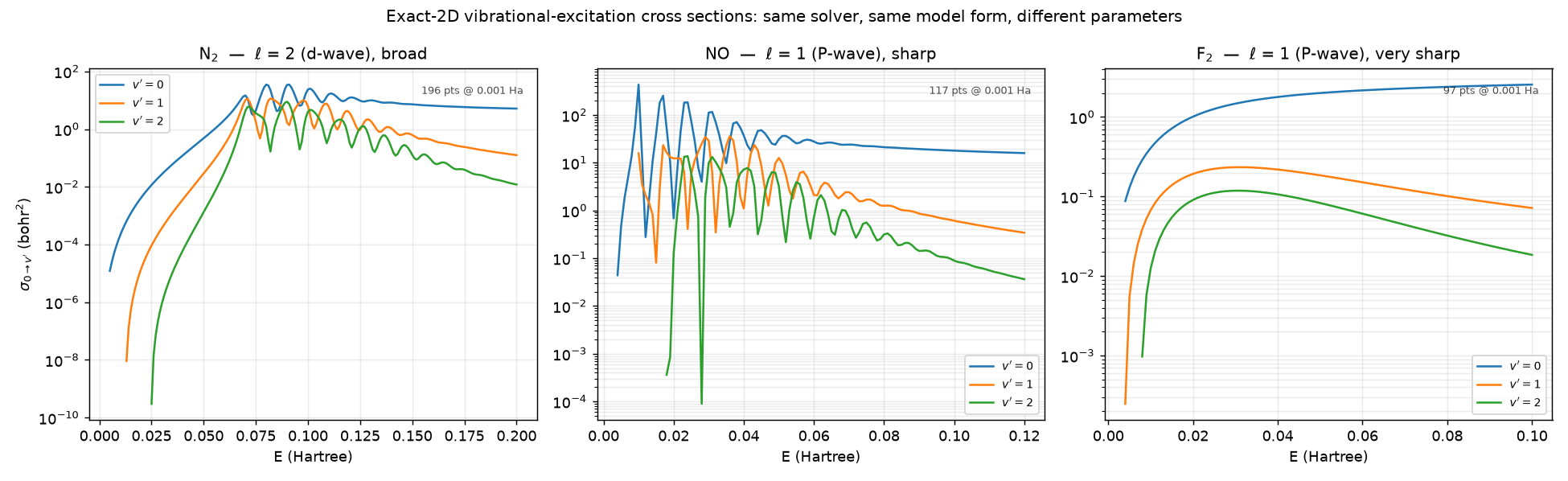
N₂’s broad d-wave resonance vs NO/F₂’s sharp low-lying P-wave ones, all from the same model
and the same qscat.core solver — only the parameters differ.
Dissociative attachment (DA) — the second exit channel¶
Beyond vibrational excitation (VE — the electron re-emitted, e⁻ + AB(v=0) → AB⁻* → e⁻ + AB(v')), the transient anion AB⁻* can dissociate: e⁻ + AB(v=0) → AB⁻* → A + B⁻. The
outgoing flux is then in the nuclear coordinate (R→∞) rather than the electronic one. eMoScat
measures it with a second test function on the nuclear coordinate (Model2d/MultiTestFunction2d.cpp,
TestFunction2d.cpp, Potentials2d.cpp): the DA exit channel is
Φ_DA(r,R) = φ_e(r) · F^out_R(R),
where φ_e(r) is the anion’s bound electronic state at the dissociation limit — the bound
eigenstate of the electronic Hamiltonian \(-\tfrac{1}{2}\partial_r^2 + v_0(R_\infty) + l(l+1)/2r^2 - \lambda(R_\infty)e^{-\alpha_c r^2}\)
(Neutral2dPotential at the outer nuclear edge; λ(R_∞) → λ_inf) — and F^out_R(R) is the
outgoing nuclear wave \(\sqrt{\mu/2\pi k_R}\;e^{i k_R R}\), with
\(k_R = \sqrt{2\mu(E_\mathrm{tot} - \varepsilon_e)}\). The cross section is
\(\sigma_\mathrm{DA} = \pi|S_\mathrm{DA}|^2/2E\) with \(S_\mathrm{DA}\) from the same Tannor-Weeks transform / driven-equation projection
as VE. This is the eMoScat convention (deck: the first, nuclear-coordinate test function; “1
transversal eigenstate” = the single bound anion electronic state).
Thresholds (computed here, validated against the physics): \(\varepsilon_e(R_\infty)\) minus eps[0] in collision
energy —
anion ε_e (Ha) |
DA threshold (E_coll) |
status |
|
|---|---|---|---|
N₂ |
−0.243 |
+0.502 Ha |
closed in the measurement range — matching eMoScat disabling N₂’s DA |
NO |
−0.060 |
+0.172 Ha |
opens above the resonance |
F₂ |
−0.127 |
−0.069 Ha (exothermic) |
open at all E>0 — matching F₂’s famously strong dissociative attachment |
There is exactly one bound anion electronic state per molecule (a real eigenvalue below a complex ECS continuum), matching “1 transversal eigenstate.” F₂’s exothermic DA and N₂’s closed channel are the key physical validations of the setup.
The DA cross section — a TIME-INDEPENDENT driven-equation T-matrix (eMoScat
time_independent_model.cpp). eMoScat computes DA (and H₂⁺ DR) exactly and time-independently,
via the SAME driven equation as VE (\(\Psi_+ = \Psi_i + (E-H)^{-1} V_\mathrm{int} \Psi_i\)) but projected onto the DA
exit channel with the rearrangement interaction
i.e. \(H - H_\mathrm{final}\), NOT V_int,
and the DA T-matrix
\(T_\mathrm{DA} = \langle \phi_e(r)\,F^\mathrm{nuc}_{K_R,0}(R) \,\vert\, V_\mathrm{DR} \,\vert\, \Psi_+ \rangle\), \(\sigma_\mathrm{DA} = 4\pi^3|T_\mathrm{DA}|^2/2E\) —
where \(\phi_e\) is the anion bound electronic state at the dissociation limit and F^nuc is the
energy-normalized regular nuclear Bessel (\(l=0\), mass \(\mu\)), \(K_R = \sqrt{2\mu(E_\mathrm{tot} - \varepsilon_e)}\). (An earlier
prototype of mine used V_int instead of V_DR and got a ~10⁶ unitarity violation — that was
the bug, NOT a structural obstacle to a TI DA.) With V_DR, σ_DA is O(1) bohr² and within the
unitarity cap \(\pi/2E\) for F₂; N₂/NO closed (correct). Implemented in
qscat.core.dissociation (anion_electronic_states, v_dr_diag, da_cross_section).
The discretisation must be per-molecule. DA’s outgoing flux is in the NUCLEAR coordinate, and
the heavy nuclei make the exit wave \(F^\mathrm{nuc} = \sqrt{2\mu/\pi K}\,\sin(K_R R)\) oscillate fast (F₂:
K_R ≈ 58, wavelength ~0.107 bohr). On the single N₂-style nuclear grid (1.0-bohr outer
elements) σ_DA did NOT converge — it swung 0.16 → 26 → 0.54 → 2.3 → 4.0 bohr² as the nuclear
quadrature was raised, because increasing points-per-element (p-refinement) cannot resolve an
oscillatory integrand; element density (h-refinement) must. The fix is eMoScat’s already-tested
per-molecule grids (reference/eMoScat/input/{NO,F₂}/grids.txt), whose nuclear grids are far
finer over the dissociation region (NO: 37×0.2 bohr over [1.6, 9.0]; F₂: 40×0.2 bohr over
[2.7, 10.7] plus 0.024 bohr around the 2.5–2.7 resonance). On the F₂ eMoScat grid (nuclear
n = 974, R0 = 10.7) σ_DA(E=0.03) = 1.66 bohr², stable to < 0.002 % under a
quadrature-order refinement (nuc_quad 14→16) of that already-fine mesh — the coarse-grid 25.99
was a pure quadrature artifact. (A full element-doubling h-refinement at this ~10⁵-unknown deck
size exceeds a laptop’s memory; confirming it needs the Docker+MUMPS backend — a follow-on.) qscat.core.grids.segmented_grid
builds any such deck; validation.diatomic.config.MoleculeConfig.da_grid() carries the NO/F₂
decks. This distinction is why VE converged on the coarse nuclear grid but DA did not: VE’s
outgoing flux is electronic (needs fine electronic resolution, already validated at
r_max = 16), DA’s is nuclear — they stress different coordinates.
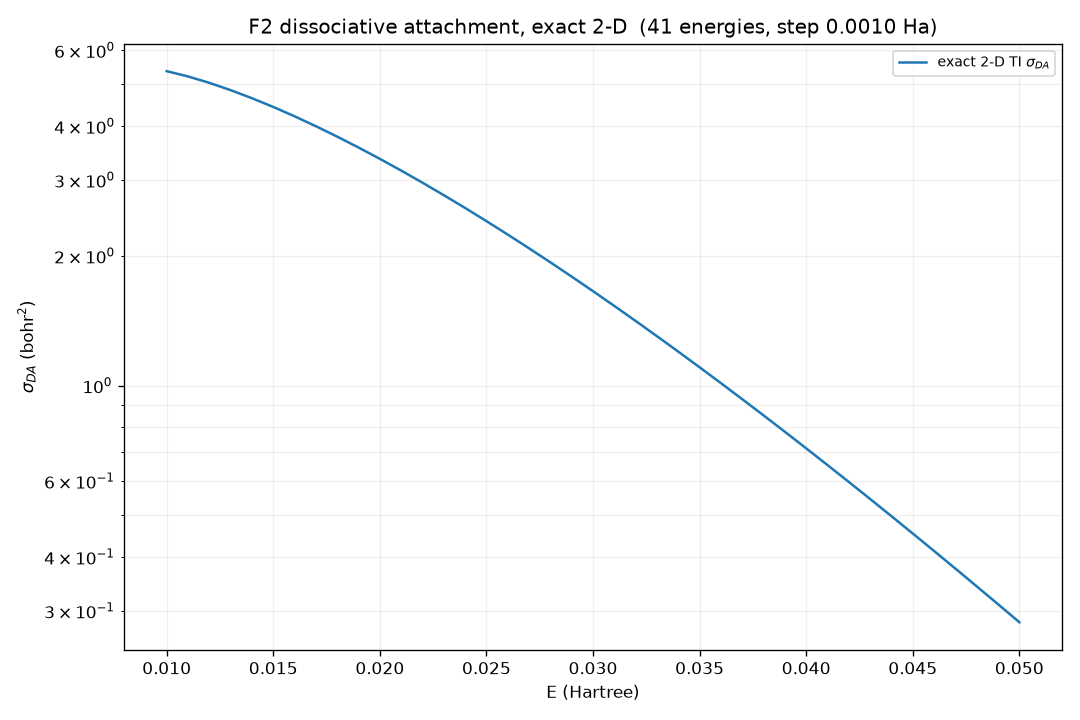
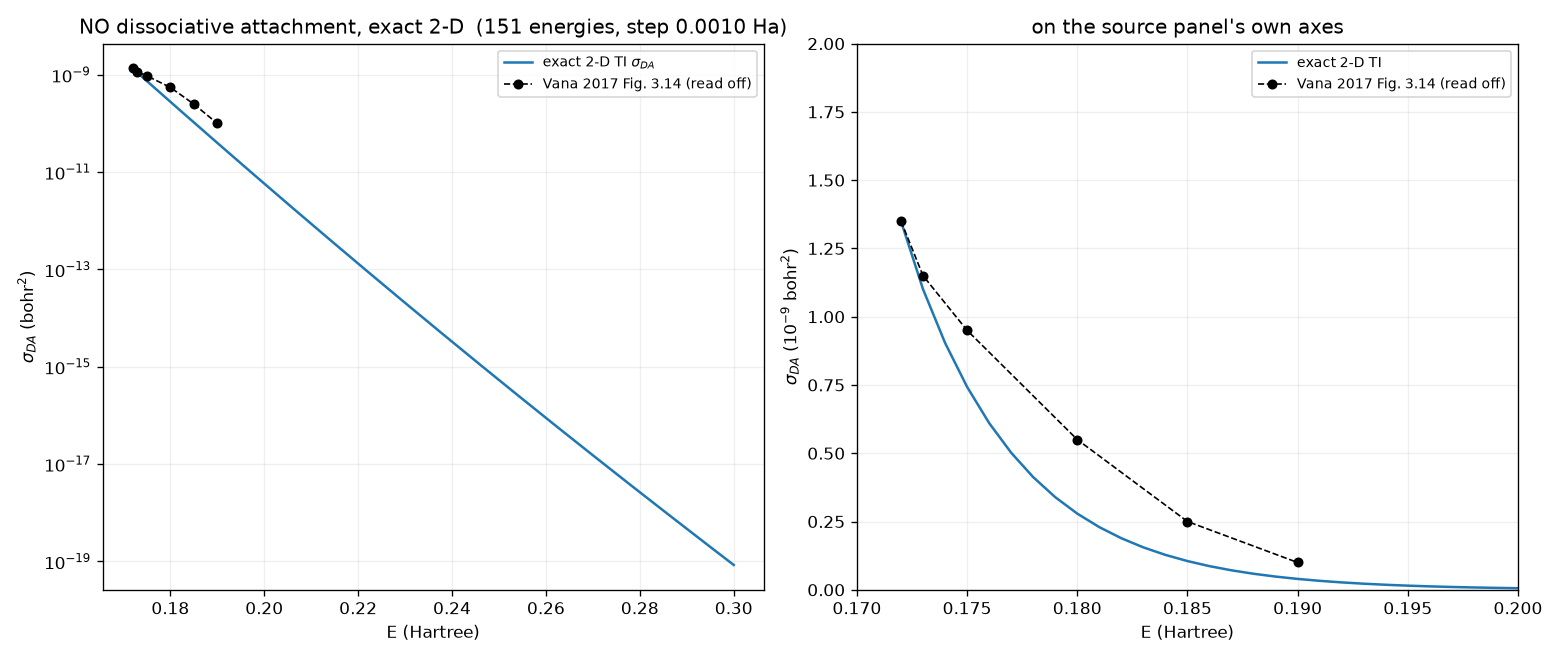
The exact-2D TI σ_DA(E) oracle curves on those grids (F₂ exothermic; NO opening ~0.17 Ha):
Automatic discretisation. The eMoScat decks above are hand-tuned; qscat.tuning (the
discretisation-tuner skill) now computes a grid from the potential curve alone — an
equidistribution mesh bounding the per-element de Broglie phase, an h/p quadrature sweep, and a
double-ECS-safe tail — calibrated and gated against exactly these N₂/NO/F₂ decks, including F₂’s
K≈58-78 DA wave. See docs/physics/discretisation-tuning.md.
H₂⁺ DR is the same T-matrix looped over the neutral’s MANY bound electronic (Rydberg) states
a Coulomb incident (
coulomb::sF_en). See the DA design spec.
Dissociative recombination (DR) — H₂⁺, many channels¶
The same machinery generalizes to dissociative recombination for a molecular ion
(e⁻ + AB⁺ → A + B): the exit channels are the multiple bound electronic states of the
neutral AB at large R (a Rydberg series → in principle infinitely many, cut off at a
measurable number). This is the H₂⁺ case — deferred with the Coulomb tail (the ionic
sphHankel1En Coulomb branch exists in eMoScat), but structurally it is “DA with N electronic
channels instead of 1.”
Local-complex-potential (LCP) DA — the approximation under test¶
The exact-2D DA above is the ORACLE. The local-complex-potential (LCP) model is the
approximation: it reduces the full electron–nuclear problem to a 1-D nuclear problem on a
complex potential \(V_d(R) - i\Gamma(R)/2\), where the fixed-R electronic resonance pole gives
\(V_d(R) = \operatorname{Re} E_\mathrm{pole}(R)\), \(\Gamma(R) = \max(0, -2\operatorname{Im} E_\mathrm{pole}(R))\). Implemented model-independently in
qscat.core.lcp: local_complex_potential finds E_pole(R) by two-angle ECS matching
(qscat.ecs.find_resonance_pole) of −½∂²_r + model.surface(r,R), seeded from the bound anion
state at R_inf (anion_electronic_states) and continued inward (validated against the N₂
vres_on_grid oracle to ~1e-5). lcp_da_cross_section is the time-independent resolvent form
(the T→∞ limit of eMoScat’s ModelLCP/SMatrix.cpp doorway propagation, cheaper and
confound-free): from the doorway \(d = \sqrt{\Gamma/2\pi}\;\chi_{v_0}\), solve
\(\psi_\mathrm{sc} = (E_\mathrm{tot}\mathbb{1} - H_\mathrm{res})^{-1} d\), and the
DA amplitude is the outgoing flux at the boundary \(X\),
\(S_\mathrm{DA} = \sqrt{K/2\pi\mu}\;\psi_\mathrm{sc}(X)\),
\(\sigma_\mathrm{DA} = 4\pi^3|S_\mathrm{DA}|^2/2E\).
Two subtleties are decisive (each collapsed σ_DA by many orders when wrong): (1) the nuclear grid must be the fine per-molecule eMoScat deck — the K≈58 outgoing dissociation wave is unresolved on the coarse shared grid (σ_DA drops ~36 orders); (2) the boundary observable is the wavefunction value \(\psi_\mathrm{sc}(X) = \psi_\mathrm{sc}^\mathrm{coeff}[b]/\sqrt{w_b}\), NOT the raw DVR coefficient (a √w boundary-weight factor, ~27× in σ). These are the same lessons as the exact DA (per-molecule grid) plus a DVR-normalization one.
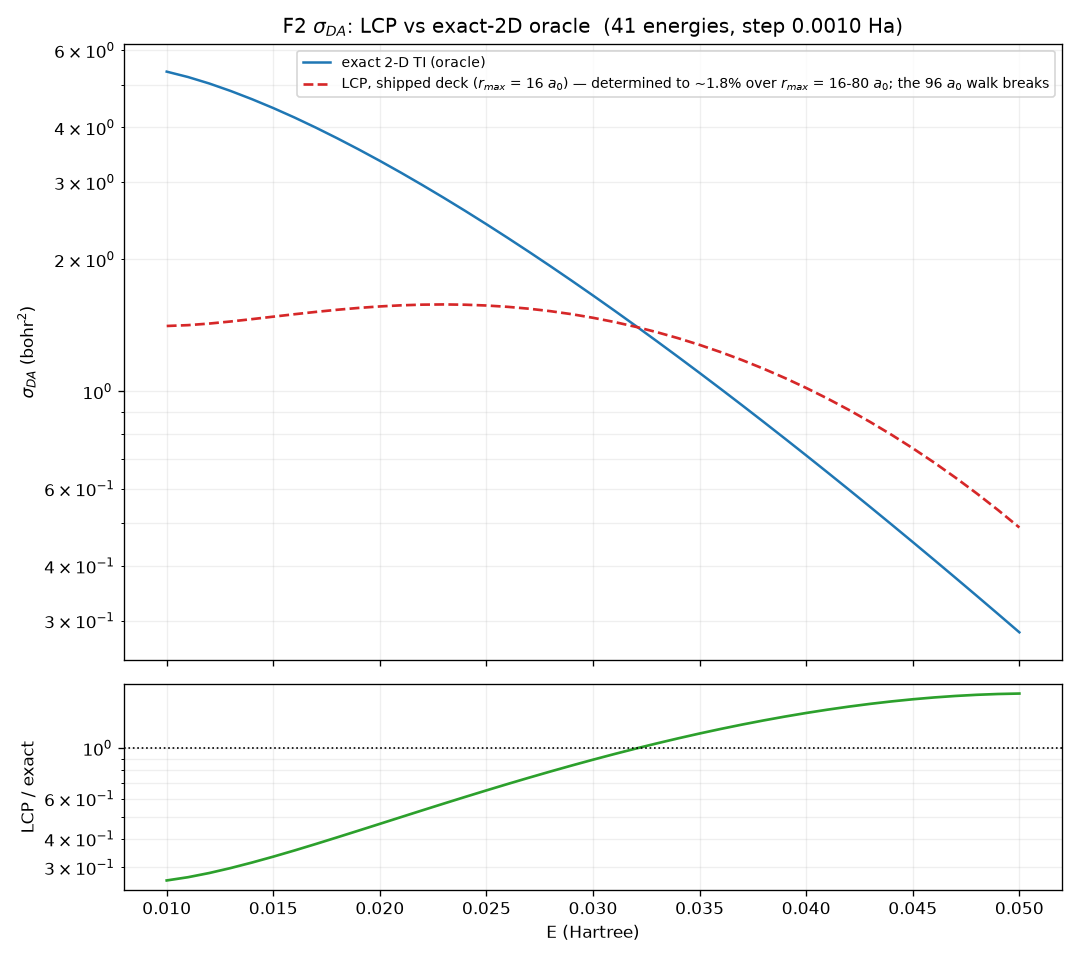
Result (F₂). The LCP’s error is systematic and energy-dependent — there is no plateau of agreement. Recomputed 2026-08-17 at 41 energies (0.010–0.050 Ha, step 0.001):
E (Ha) |
σ_DA LCP |
σ_DA exact-2D |
LCP/exact |
|---|---|---|---|
0.010 (threshold) |
1.410 |
5.366 |
0.263 |
0.020 |
1.56 |
3.36 |
0.47 |
0.030 |
1.471 |
1.656 |
0.888 |
0.040 |
1.02 |
0.72 |
1.43 |
0.050 |
0.490 |
0.282 |
1.736 |
The exact σ_DA falls monotonically by a factor of 19 across this range while the LCP stays
nearly flat, so the ratio sweeps 0.263 → 1.736, crossing unity near E ≈ 0.032. Earlier
versions of this note described the LCP here as “a good approximation away from threshold”,
and CLAUDE.md quoted “~11% of exact” — both were reading the single crossing point as if it
were a characteristic agreement. It is not: the LCP under-predicts below ~0.03 and
over-predicts above it, and only passes through good agreement on the way.
That sweep is a real property of F₂’s deck, and it was checked rather than assumed.
The LCP’s V_d/\(\Gamma\) come from an ECS resonance-pole walk, which is not guaranteed to be
independent of the electronic box, so the walk was rerun at
r_max = 16/32/48/64/80/96 on both molecules. On F₂ five of the six agree to ~1.8 %
— the shipped deck’s curve is determined, and only r_max = 96 breaks, to a ratio range
of [0.027, 3.51]. On NO the spread is 3.98 × 10⁴, non-monotone across the whole
range, with the larger boxes producing deep oscillatory minima spanning 1e-6 to 1e-1
where the shipped deck is smooth and flat.
The distinction matters, because the two failures are not the same kind: on F₂ the
LCP’s V_d/\(\Gamma\) are determined and wrong by the documented energy-dependent factor;
on NO they are undetermined — a second defect, in NO’s pole walk, independent of the
volume-T-matrix one and still unfixed.
Those extra walks are not plotted, deliberately. They are not alternative estimates
of the same quantity: on NO the walk does not converge, so they are failed computations,
and drawing them beside a real curve would invite a reader to average them or to read
the spread as an uncertainty band. What the ladder establishes is a yes/no — whether the
method determines V_d/\(\Gamma\) on that molecule at all — which is a sentence, not a curve.
Each figure’s legend carries its own verdict, and
validation/diatomic/da_figure.py --ladder recomputes the spread on demand.
(The older 13-point curve was not wrong — its endpoints match this dense run exactly — it was simply too sparse to show that the ratio never settles.)
The physically-sensible departures the comparison exists to expose (the exact solver is
the oracle, the LCP is under test): (a) it under-predicts the near-threshold spike — the
exact σ_DA rises sharply as E→threshold while the LCP stays smooth (0.263 at E=0.010);
(b) for the sibling VE channel, the LCP elastic omits the non-resonant background that the
exact elastic T-matrix contains (driven.py documents this) — a known qualitative LCP
limitation. The LCP VE cross section itself is not computed in this sub-project, so no
quantitative LCP-VE band is recorded in this note. It is computed elsewhere:
validation/diatomic/ve_nrm.py runs it (as qscat.core.lcp. lcp_ve_cross_section, the graduated 1-D solver) alongside the exact and nonlocal routes, and
docs/physics/nrm-vibrational-excitation.md §4 publishes the measured
LCP-over-exact bands for N₂ and F₂. N₂’s DA channel is closed (threshold +0.5 Ha), so
LCP and exact both give ≈0 there — a consistency sanity, no figure.
NO — where the LCP fails outright. 151 energies (0.150–0.300 Ha, step 0.001), recomputed 2026-08-24 with the flux extraction. The exact σ_DA peaks at 1.349 × 10⁻⁹ bohr² at E = 0.1720 and decays smoothly, by ten orders of magnitude, to 8.47 × 10⁻²⁰ at E = 0.300. The LCP does not decay: it stays near 10⁻⁴ across the whole range. The ratio therefore runs from 9.70 × 10⁴ near the peak to 4.84 × 10¹⁴ at the top of the range, never crossing unity — unlike F₂, where it sweeps through 1 near E ≈ 0.032.
Three earlier claims about this curve are withdrawn, all of them artefacts of the
volume-form extraction (nonlocal-resonance-model.md §7.2.1):
the “sharp spike at threshold, peak 0.0925 bohr²” — there is no spike; the true peak is 1.349e-9 and the curve is smooth;
“thirteen orders of magnitude” and the ratio “1.8 × 10⁹” — both were reading the cancellation residue, not the cross section;
the oscillations, which this note previously read as structure. They were structure in the residue. The converged curve has none.
The far tail is real, not a floor: flux extraction at r_max 16 against 48 agrees
to 5–6 significant figures even at 8.4568e-20 (E = 0.300), where the volume route’s
two boxes differ by 5460×.
The LCP curve on the figure below carries its own, separate caveat — NO’s ECS pole
walk does not converge in r_max, so that curve is one member of a family the method
does not pin down. Its legend says so.
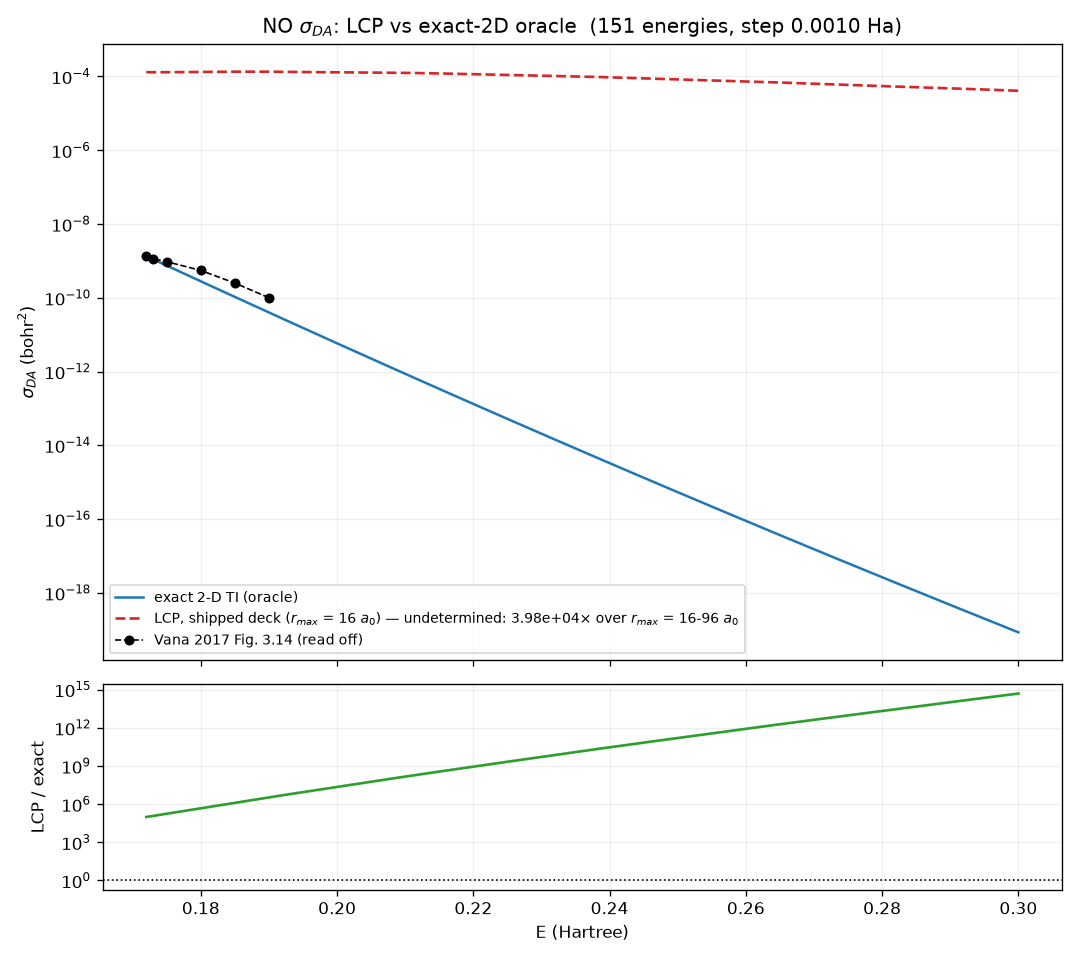
This is a far stronger statement than the “shown for completeness, not a quantitative agreement claim” hedge this note previously carried, and it is the more useful result: the local-complex- potential approximation does not reproduce the exponential suppression of dissociative attachment away from threshold at all. On a 12-point curve at a 0.0136 Ha step that behaviour was not visible; on the dense curve it is the dominant feature.
The LCP’s verdict is observable-dependent — do not generalise either way. The results above
are about σ_DA cross sections for F₂ and NO, and they are unflattering. Measured on a
different observable the same approximation does very well: for N₂’s resonance levels, the
BO + local approximation agrees with the exact (non-BO) 2-D poles to sub-meV in both position
and width (docs/physics/exact-2d-resonances.md). Neither result licenses the other. An
approximation that reproduces where a resonance sits need not reproduce how much flux leaves
through a particular exit channel, and here it does not.
Time-dependent route — validated on N₂, not attempted for NO or F₂¶
The N₂ time-dependent route (order-3 Padé + Tannor-Weeks, qscat.core.time_dependent) matches
the exact TI oracle to a median of 0.2 % across 161 energies spanning 0.060–0.220 Ha, with 93 %
of in-window points inside 5 % — see docs/physics/n2-2d-td-cross-section.md.
NO and F₂ have sharper, lower-lying resonances than N₂, so a TD route for them has not been attempted and remains the natural follow-on, gated against the exact-2D TI oracle delivered here.
What this note used to say, and why it was withdrawn. It previously argued that NO’s and F₂’s “~0.004–0.01 Ha boomerang features are at or below the finite-time-propagation resolution \(2\pi/T\)”, so TD-vs-TI agreement at the N₂ level should not be expected without a long-propagation study. That reasoning was inherited from a claimed finite-T resolution limit in the N₂ note which has since been disproved: those measurements came from an order-1 Crank-Nicolson propagator, and at order-3 Padé the same energies track the oracle (E = 0.06/0.08/0.12 moved from ratios of 0.229/0.575/0.348 to 0.997/0.958/1.015). There is no established \(2\pi/T\) barrier to inherit, so this note no longer offers one as a reason to expect poor agreement — or as a reason not to try.
A genuine caution does remain, and it is a different one: NO’s cross sections really do carry
sharp structure. Its v’=1 excitation is measured to swing 34.76 → 6.13 bohr² across a single
0.002 Ha step (validation/diatomic/test_diatomic.py). Resolving that is a sampling question
for whoever runs the TD study, not a predicted failure of the method.