Watching the nonlocal kernel run — a walkthrough¶
A companion to nrm-time-dependent.md §8, which is
written as a record and is dense on purpose. This one is written to be read once,
in order, to understand what was built and what it found.
Everything here is measured. Where a claim was made and later withdrawn, the withdrawal is part of the story rather than an erratum — three of them were, and the sequence is the most useful thing in this document.
1. The idea¶
The nonlocal resonance model replaces the LCP’s local width \(-i\Gamma(R)/2\) with an energy-dependent, nonlocal kernel \(F(E,R,R')\). The time-independent route solves with that kernel and returns a cross section. It tells you nothing about how the answer came about.
The time-dependent route does, because of how the kernel is represented. Writing
and giving each term its own auxiliary nuclear packet \(\varphi_n\) turns the memory integral into time-local propagation under a sparse arrow matrix \(H_{\mathrm{ext}}\): the doorway state \(\Psi_d\) couples to every arm, the arms couple to nothing else. Eliminating the arms reproduces PRA 77 Eq. (55) exactly (gated at \(4.4\times10^{-14}\)).
The arms are the memory. So they can be watched.
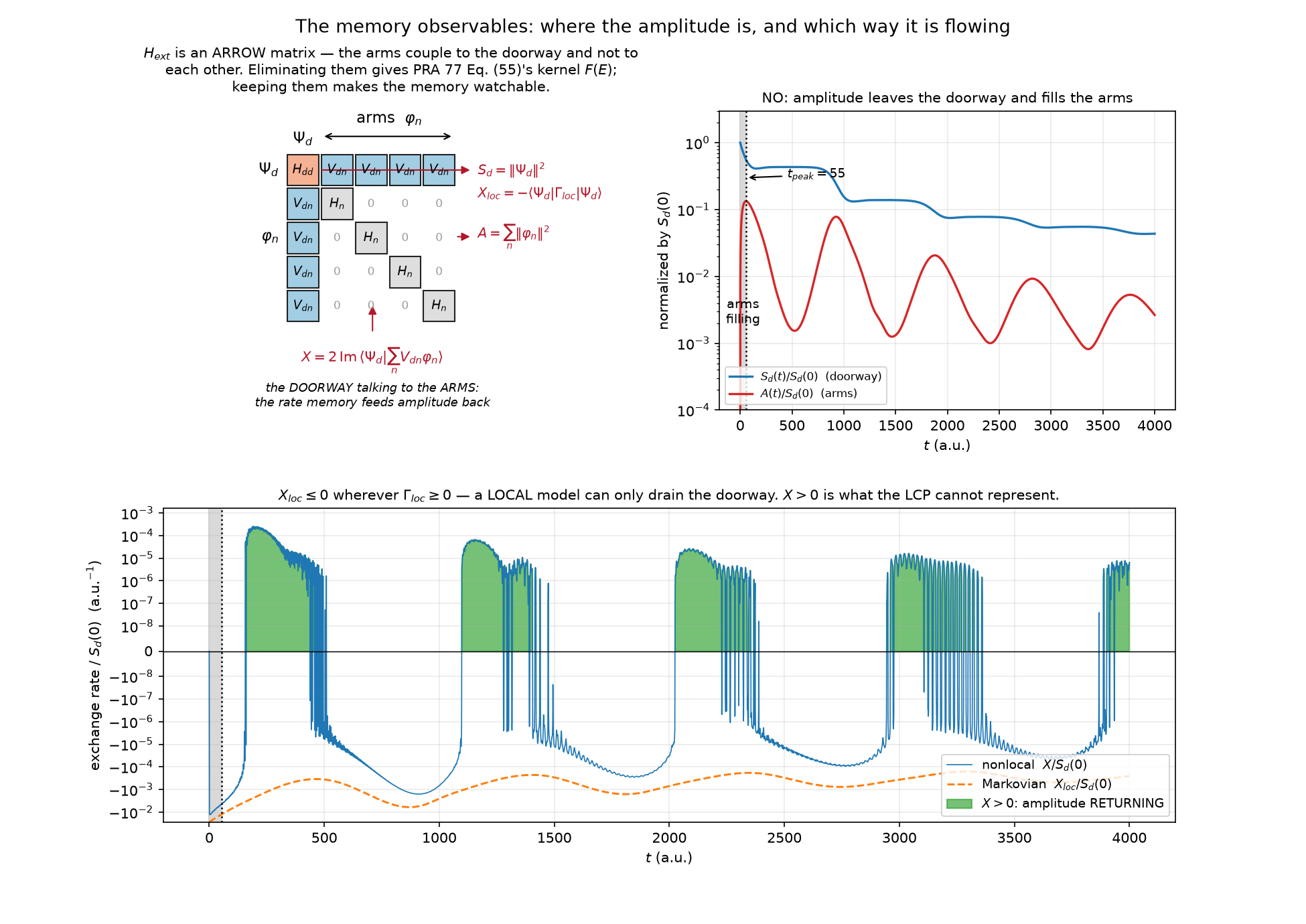
Three series are recorded during the same propagation that produces the cross section, at a measured cost of +0.33 %:
what it is |
what it means |
|
|---|---|---|
\(A(t) = \sum_n \lVert\varphi_n\rVert^2\) |
|
where amplitude sits, by channel |
\(X(t) = 2\,\mathrm{Im}\langle\Psi_d\lvert\sum_n V_{dn}\varphi_n\rangle\) |
|
the rate memory feeds the doorway |
\(X_{\mathrm{loc}}(t) = -\langle\Psi_d\lvert\Gamma_{\mathrm{loc}}\rvert\Psi_d\rangle\) |
|
the same rate in the local limit |
The comparison is the whole point. \(X_{\mathrm{loc}} \le 0\) wherever \(\Gamma_{\mathrm{loc}} \ge 0\): a local model can only drain the doorway. So \(X > 0\) is amplitude coming back — the thing the LCP cannot represent at all, made visible as a sign.
The bottom panel above is NO, and the green regions are exactly that: five distinct bursts of returning amplitude, on a molecule whose LCP is known to be badly behaved.
One thing arm_norm is not¶
It is not a population. Under ECS \(H_{\mathrm{ext}}\) is complex symmetric, so
no conjugating norm is conserved. The size of the gap was measured rather than
assumed: the coupling’s two one-sided rates differ by a median 0.822 of the
larger. That is the same size as the transfer, not a correction to it. So
arm_norm is a relative channel decomposition — read across channels and
against itself over time — and the figure’s curves are not drawn as if they
summed to anything.
2. The first result, and why it needed three attempts¶
The obvious next step is to count returning steps per molecule and rank them. That is what the sub-project first did, and it was wrong three times before it was right. The corrections are worth more than the original claim.
2.1 The pointwise sign of the exchange rate is not converged — on any molecule¶
Refine \(dt\) and the sign-flip period does not lengthen in atomic units. It shrinks, staying at roughly two steps whatever the step is:
\(dt = 1\) |
\(dt = 0.5\) |
\(dt = 0.25\) |
|
|---|---|---|---|
F₂ |
2.09 a.u. |
0.84 |
0.52 |
N₂ |
7.33 |
1.34 |
0.72 |
NO |
34.5 |
3.19 |
— |
A structure that sits at the step scale at every step size is being measured at the wrong resolution. That this is time discretisation and nothing else was checked rather than assumed: each campaign deck was re-propagated on a different CPU, BLAS and sparse factorisation (x86 + MUMPS against arm64 + SuperLU) and reproduces to \(\sim10^{-13}\) with 100 % sign agreement.
2.2 So the returns are compared on time-averaged bins¶
Bursts hundreds of a.u. long are the physical object; single steps are not. The comparison is made on binned averages at four widths, so the width cannot be doing the work.
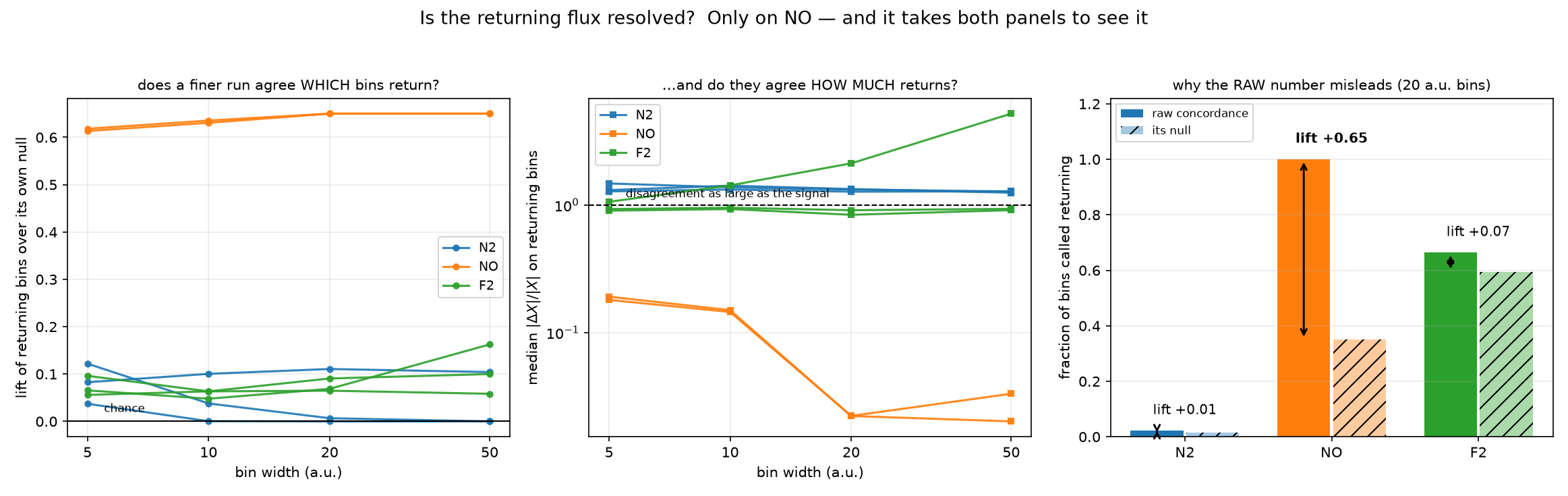
Two columns are needed, and the middle panel is why. Agreeing about the sign of a bin says nothing about its size. NO’s binned returns agree to 2–19 %; N₂’s and F₂’s differ by more than they are worth.
The right-hand panel is the correction that mattered most. The concordance is conditional — “of the bins this run calls returning, how many does the finer one?” — so its null is the finer run’s own positive-bin rate, not one half. That rate is ~0.59 on F₂ and ~0.35 on NO. Read raw, F₂ scored 0.65 and looked like a middle band; read against its null it is a lift of +0.07, essentially chance. NO’s 1.00 is a lift of +0.65.
Verdict: two bands, not three. The returning flux is readable on NO alone. N₂ and F₂ are both at chance and are not ranked against each other — which of the two looks larger even reverses between the pointwise and binned metrics.
The bin metric was introduced after the pointwise one failed, which is the classic shape of rescuing a claim. Note which way it cut: it did not save N₂, and once its null was supplied it removed F₂ as well.
3. The comparative question, and the trap in it¶
The question the campaign existed to answer: in the energy domain the LCP’s failures are ordered N₂ (mild) then F₂ (sweeping through unity), with NO undetermined — its pole walk does not converge. Does the time domain reproduce that, and can it place NO?
The returning flux cannot carry a three-way comparison, being readable on one
molecule. So the ordering was read from nonlocality,
which is measurable on all three and converges under refinement (N₂ 0.6 % over four runs, NO 0.04 %, F₂ 1.9 %). At the campaign energies it reads N₂ 0.507 < NO 0.813 < F₂ 0.946 — the ordering, with NO placed.
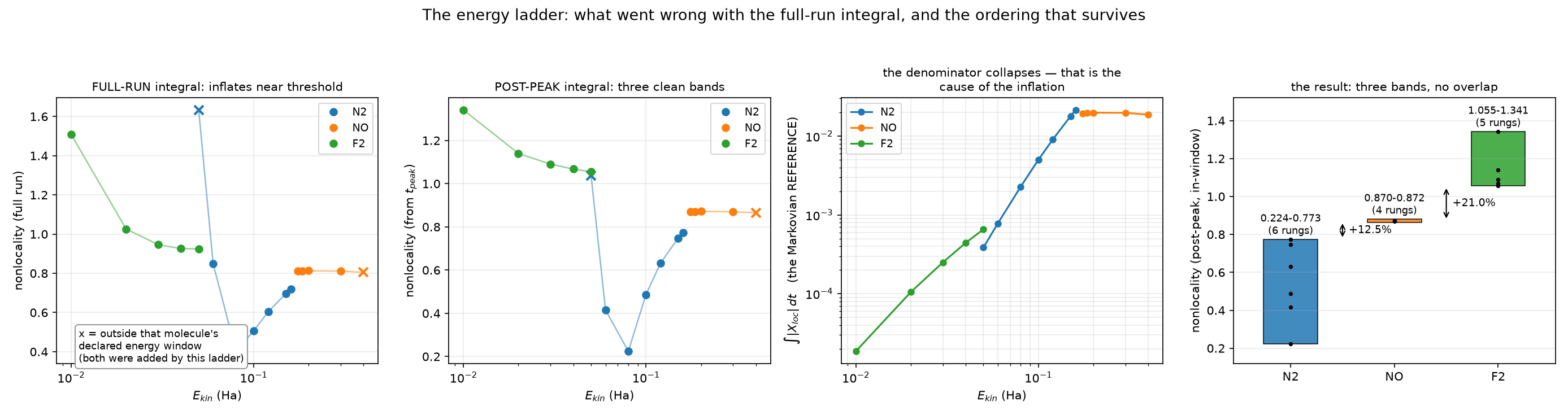
But the three molecules run at three different energies, each set by where its own channel is open. So the comparison had to survive being a comparison in energy. All three were laddered — seventeen propagations.
3.1 What the ladder found¶
Every column the campaign reads as a return is frozen: over a 4–6× change
in \(\Gamma_{\mathrm{eff}}\) the onset does not move at all and
max positive / peak moves in the fifth figure. Those describe the molecule.
nonlocality is not frozen — and in its original form it was not even the right
integral. The left panel shows why: it blows up toward threshold on N₂ and F₂,
and N₂ becomes non-monotone, which is enough to destroy any ordering read from
single energies. This is where the claim was retracted outright.
3.2 The mechanism, and the fix that follows from it¶
The retraction was an over-reaction, and finding out why produced the real result.
With the arms still empty, \(X = 0\), so \(\lvert X - X_{\mathrm{loc}}\rvert = \lvert X_{\mathrm{loc}}\rvert\) identically and the ratio is pinned near 1 regardless of the kernel. Every propagation passes through that window. Near a threshold it takes over, because the denominator collapses — third panel: \(\int\lvert X_{\mathrm{loc}}\rvert\) falls 46× across N₂’s ladder and 35× across F₂’s — while the numerator cannot fall below that floor.
What collapses is \(\Gamma_{\mathrm{loc}}\)’s magnitude over the doorway (\(\max\Gamma_{\mathrm{loc}}\) moves 5.5× on N₂, 11.8× on F₂), not its extent (the nodes carrying it move only 89 → 95 of 153). An earlier version of the note said the open window shrinks; that was wrong and is corrected.
The contamination is a window, so the remedy is a window, not a cull. Integrating from the arm-norm peak onwards removes it from every rung, instead of discarding whole propagations for containing it. \(t_{\mathrm{peak}}\) is not a tuned knob: it is identical at every energy within a molecule (18 / 55 / 40 a.u.) and starting at \(2t\) or \(3t\) gives the same verdict.
An intermediate version did cull — four rungs, by a threshold invented after
the ladder was run. It worked, but it was open to the charge that a criterion had
been fitted to the answer, and it could not support N₂ < NO at all: N₂’s
in-window 0.06 Ha rung read 0.848 there, above NO. Post-peak that same rung
reads 0.416.
3.3 The result¶
The only exclusions are the two rungs the ladder added outside the molecules’ own declared energy windows — N₂ at 0.05 Ha and NO at 0.40 Ha — by a criterion this module has carried since before the ladder existed, applied to both.
N₂ |
NO |
F₂ |
|
|---|---|---|---|
in-window rungs |
6 |
4 |
5 |
nonlocality (post-peak) |
0.224–0.773 |
0.870–0.872 |
1.055–1.341 |
margin to next band |
— |
+12.5 % |
+21.0 % |
If only one inequality can be quoted, quote NO < F₂. It holds on the raw
full-run column too, over all seventeen rungs (NO’s max 0.8134 against F₂’s min
0.9246), needing no argument about windows at all. N₂ < F₂ holds with a wide
margin. N₂ < NO is the narrowest at 12.5 % and is the first to re-examine.
Both inequalities are tightest at a window edge — N₂ rises with energy and its top rung is the top of its window; F₂ falls and its lowest rung is its closest approach to NO. Neither trend is extrapolated.
4. What this does and does not establish¶
Reproduced. The energy domain determines N₂ < F₂. The time domain agrees.
Added. NO, which the energy-domain route cannot rank at all because its pole walk does not converge, is placed between them — by a route that never calls a pole walk.
Withdrawn, and this one is a genuine negative result. “NO’s memory is
energy-independent” is not supported. Its nonlocality is flat to 0.3 % across
its whole declared window — but so is everything feeding it:
\(\Gamma_{\mathrm{eff}}\) spans 1.02× and the Markovian reference 1.06×, against
4–6× and 35–46× on the other two (visible as the flat orange line in the third
panel above). The perturbation that moved N₂ and F₂ was never applied to NO.
Flatness of an output under an input that did not move is not a measurement.
Not established. Any ranking of N₂ against F₂ by the returning flux — that observable is readable on NO alone. And the ordering is a statement about ranges over each molecule’s declared window; outside those windows the observable stops measuring the kernel, so it is not extrapolated.
Not evidence for the model. Every number here is read off a propagation whose cross section is validated elsewhere (§3 and §7 of the main note). These are diagnostics of a model already gated; none of them validates anything in turn.
5. Reproducing it¶
# one propagation per molecule per energy; F2 is the largest at H_ext = 81816
# and peaks at 5.82 GB (it fits on a laptop; MUMPS in Docker is ~10x faster)
uv run python -m validation.diatomic.memory_observables N2
uv run python -m validation.diatomic.memory_observables F2 --energy 0.02

# refinement checks behind §2
uv run python -m validation.diatomic.memory_observables NO --order 4
uv run python -m validation.diatomic.memory_observables NO --dt 0.5 --steps 8000
uv run python -m validation.diatomic.memory_observables resolution --against NO

# the campaign table, and this document's figures
uv run python -m validation.diatomic.memory_observables report
uv run python -m validation.diatomic.memory_observables explain
Every recorded number lives beside the code that produced it, in
validation/diatomic/memory_observables.py: ENERGY_LADDER (17 rungs),
ENERGY_WINDOWS, RESOLVED_RETURN and COARSE_GRAINED_RETURN (with their
nulls), CROSS_PLATFORM, E_BOX_LADDER, DECK_COST. The gates in
test_memory_observables.py assert the claims and the criteria they depend on,
so neither can drift without the other being re-examined.
6. The three retractions, in one place¶
Because they are the most transferable part of this work.
N₂’s returning-flux claim. Made on a run whose pointwise sign is not converged, and on an electronic box 22 % wrong in \(\Gamma_{\mathrm{loc}}\). Withdrawn.
F₂’s “middle band” of returning flux. An artefact of quoting a conditional concordance against an unconditional null; F₂ has the highest positive-bin rate of the three, so it flattered itself most. Withdrawn.
The ordering — retracted, then restored. The retraction was made on the full-run integral with near-threshold rungs in it. Restoring it required understanding why those rungs inflate, and the understanding produced a better observable rather than a better excuse.
A fourth, smaller one: a correlation claimed to reverse inside the valid set (evidence that a criterion was not circular) turned out to be small-sample noise — it was measured on thirteen rungs and vanished at seventeen. Only the weakness of the correlation survives, and that is all that is now claimed.